









An Uncompromising Vision
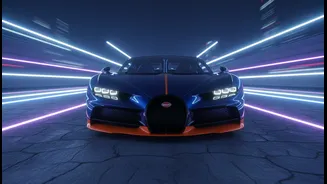
To understand the surprise, you first have to understand the Bolide. Unveiled as the ultimate expression of Bugatti's legendary 8.0-litre quad-turbo W16 engine, it was a machine built exclusively for the racetrack. With just 40 units produced, each with
a pre-tax price tag of around €4 million, the Bolide was never intended to see a public road. Its design was dictated entirely by aerodynamics and weight-saving, generating immense downforce and tipping the scales at a remarkably low 1,450 kg. The original car didn't even have conventional headlights, because racetracks are typically illuminated, and every gram saved was a gram dedicated to speed. It was, in every sense, a pure, unapologetic track weapon.
Signs of a Street-Legal Shift
This is why the recent reveal at the Goodwood Festival of Speed was so significant. A Bolide appeared, but with crucial changes. British engineering firm Lanzante Limited, famous for converting track-only monsters into road-legal cars, showcased the world's first Bolide prepared for public tarmac. The most obvious changes are the additions of street-legal necessities. New, X-shaped LED headlights have been cleverly integrated into the car's aggressive front end. A number plate is now mounted at the rear. And, perhaps most tellingly, the suspension has been softened. This doesn't mean it’s become a comfortable cruiser, but the changes were necessary to handle the imperfect surfaces of real-world roads, from potholes to speed bumps.
The Lanzante Connection
Crucially, this is not a new model from Bugatti itself, but a specialist conversion by Lanzante. The firm has a long and storied history of this kind of work, most famously converting the Le Mans-winning McLaren F1 GTR for road use decades ago. The project is a private commission, turning the track-only hypercar into a road-viable machine. This involves far more than just bolting on lights. Lanzante had to address everything from emissions compliance and exhaust systems to transmission mapping and replacing the expensive, short-lived Michelin racing slicks with more practical road tyres. The original track tyres last only about 60 kilometers. While Bugatti didn't need to alter the W16 engine for the original Bolide to be compliant, Lanzante's work ensures the entire package is legal for public use.
Taming the Beast, Not Breaking It
The engineering feat is making these changes without fundamentally breaking the car's spirit. The goal is to make the Bolide usable on the road, not to dilute its performance. Even with the modifications, the car retains its 1,600 horsepower W16 engine and its dramatic, aerodynamically-sculpted carbon fibre body. The Lanzante conversion keeps the visual drama of the standard Bolide intact; at a glance, it is difficult to tell it has been re-engineered for the road. The essence of the car remains, but its boundaries have been expanded. For an owner, it means the possibility of driving their multi-million dollar track machine to the circuit, rather than trailering it. It adds a layer of usability to an otherwise extremely limited-use asset.
A New Future for Extreme Cars
This road-legal Bolide represents a fascinating trend in the hypercar market. It suggests that even for the most extreme, track-focused cars, there is a powerful demand for road usability. While only a handful of Bolide owners will likely opt for this expensive conversion, its existence proves the desire to break free from the constraints of the track. For collectors, a road-legal version of an ultra-rare track car could represent a significant increase in value and desirability. It answers the hypothetical question, "What if?" by transforming the most extreme Bugatti ever made into something you could, in theory, drive to the local shops—a wonderfully absurd proposition.