

Pinpointing a Colossal Impact
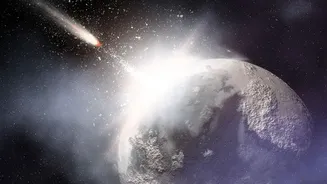
One of the most significant findings from the Chang'e-6 samples is the precise age of the South Pole-Aitken (SPA) basin, the largest and oldest impact crater on the Moon. By analysing fragments of melted rock created by the impact, scientists have dated
the event to 4.25 billion years ago. This provides a crucial anchor point for the timeline of the early solar system, a period of intense bombardment from asteroids. The sheer force of this ancient collision was enough to melt the Moon's lower crust and upper mantle, creating a vast sheet of molten rock. The samples show that the impact was so powerful it may have altered the composition of the Moon's deep interior.
A Different Volcanic Past
The samples have revealed a complex volcanic history on the far side that is distinct from the near side. Analysis of basalt fragments, a type of volcanic rock, confirms that volcanic activity was happening on the far side as recently as 2.8 billion years ago. Intriguingly, one much older basalt fragment was dated to 4.2 billion years ago. This suggests a very long history of volcanism. However, the mantle beneath the far side appears to be significantly lower in water content compared to the near side. Scientists theorise that the loss of volatile elements, like water, during the massive SPA impact may have suppressed later volcanic activity on the far side compared to the near side.
Rethinking the 'Two-Faced' Moon
A long-standing puzzle is why the Moon's near and far sides are so different. One theory involved a special type of radioactive rock known as KREEP, which was thought to be concentrated on the near side. However, the discovery of KREEP basalt in the Chang'e-6 samples from the far side challenges this idea. This finding forces a re-evaluation of theories about why the far side has a thicker crust and why the near side hosted so much more volcanic activity. The samples also confirm a long-held hypothesis that the early Moon was once covered by a global 'magma ocean'.
A Different Kind of Space Weathering
The Moon is constantly blasted by the solar wind, a stream of charged particles from the Sun. By studying noble gases trapped in the soil, scientists made another surprising discovery. Solar wind particles seem to hit the far side with more energy and penetrate deeper into the soil than on the near side. The reason? Earth's magnetic field acts as a partial shield for the near side, slowing down the incoming solar wind. The far side, which never faces Earth, receives the full, unmitigated force of the solar wind. This discovery provides the first physical evidence of how Earth's magnetosphere affects the lunar surface.
Clues from Ancient Asteroids
The lunar soil is a library of past impacts. Scientists found microscopic traces of a fragile, water-bearing type of meteorite, known as a CI chondrite, in the Chang'e-6 samples. This is the first time such debris has been confirmed on the Moon. Further analysis of metallic particles from asteroid impacts suggests that the type of asteroids hitting the Moon has changed over time. Before 2.8 billion years ago, impacts from carbonaceous asteroids (the kind that can carry water and organic materials) were much rarer than in more recent epochs. This finding has major implications for understanding when the building blocks of life might have been delivered to the Earth-Moon system.