
A Glimpse at the Sun’s Boiling Surface
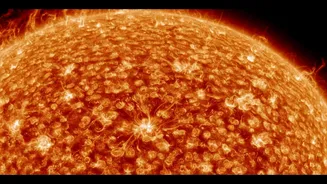
To understand the new discoveries, we first have to know what we’re looking at. The sun’s visible surface, or photosphere, isn’t solid. It’s a roiling, turbulent layer of hot plasma. Heat from the sun's deep interior travels outwards through a process
called convection, similar to how water boils in a pot. Hot plasma rises to the surface, spreads out, cools, and then sinks back down in darker, cooler lanes. This constant churning creates a grainy pattern called granulation. Each of these individual “granules” is a convection cell, typically about 1,000 to 1,500 kilometres across—roughly the size of Texas. They have very short lifespans, lasting only about 8 to 20 minutes before dissipating and being replaced by new ones. At any given moment, about four million of these granules cover the sun’s surface, creating a dynamic, ever-changing landscape.
The Eye on Our Star
The latest and sharpest images of the sun’s surface come from the National Science Foundation's Daniel K. Inouye Solar Telescope in Hawaii. As the world's most powerful solar telescope, its four-meter primary mirror can resolve features on the sun’s surface as small as 20 kilometres wide. While the telescope is an NSF facility, the research and data analysis represent a collaborative effort involving various institutions, including NASA's science divisions, which feature the findings. These new observations, released in early August 2026, provide the clearest view yet of the solar photosphere, allowing scientists to see phenomena that were previously only theorised. The images reveal a far more complex environment than previously understood, full of tiny, fast-moving structures that hold clues to the sun's biggest secrets.
Uncovering a Hidden Instability
One of the most significant findings from these new images is the first direct, unambiguous confirmation of a phenomenon known as the Kelvin-Helmholtz instability (KHI) on the sun's surface. This instability occurs when two streams of fluid or plasma moving at different speeds slide past each other, creating waves and swirls—think of how wind creates waves on water. Scientists had long predicted KHI could happen in the sun’s magnetic plasma, but had never been able to observe it directly. The Inouye telescope’s images reveal dozens of tiny, whirlpool-like vortices swirling along the dark edges of the solar granules where the sinking, cooler plasma meets the rising, hotter plasma. This discovery confirms a fundamental process that was missing from our direct observations of the sun.
Mapping a Magnetic 'Fingerprint'
Beyond just seeing these swirls, scientists can now study how they influence the sun’s magnetic fields. The images show ultra-fine magnetic “striations” or threads along the edges of the granules. These appear as alternating bright and dark lines, creating a striped effect that acts like a magnetic fingerprint. The prevailing theory is that these are delicate, curtain-like magnetic fields that get rippled by the plasma flow. The KHI vortices appear to actively mix the magnetized plasma with the non-magnetized plasma around it. This process of mixing and tangling magnetic field lines is crucial because it’s the engine behind larger solar events. The energy stored in these tangled magnetic fields can suddenly be released, powering solar flares and coronal mass ejections (CMEs).
Why These Tiny Details Matter
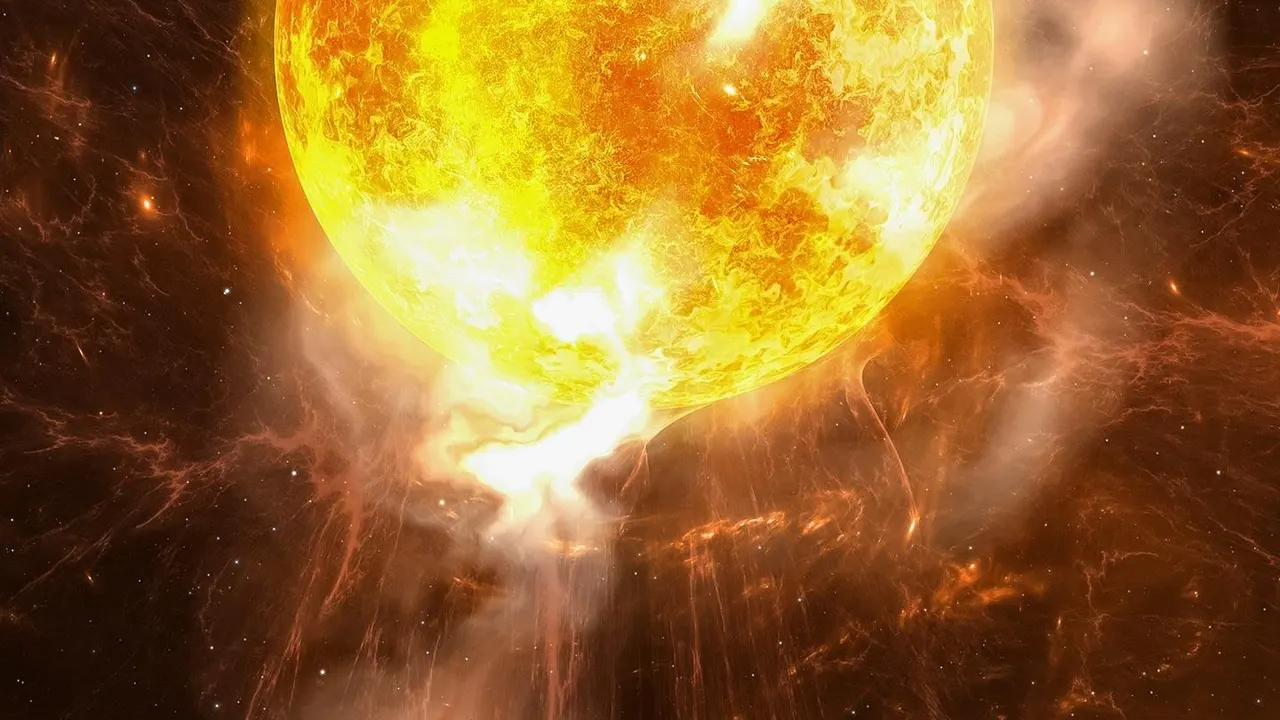
Studying city-sized details on a star might seem esoteric, but it has direct implications for us on Earth. The solar flares and CMEs that are born from these small-scale magnetic interactions can trigger powerful space weather events. These solar storms can disrupt satellites, endanger astronauts, and even knock out power grids on the ground. By understanding the fundamental physics of how energy is transported and released from the sun's surface, scientists can build better models to predict solar activity. Observing processes like the Kelvin-Helmholtz instability in real-time provides crucial data to test and refine these models. Ultimately, seeing how these tiny granules and vortices behave helps us better forecast potentially damaging solar storms and protect our technological infrastructure.