



A Ghost Particle's Clue
The story begins not with a telescope, but with a single, nearly massless particle. In 2021, the IceCube Neutrino Observatory in Antarctica detected a high-energy neutrino—a “ghost particle”—that had traveled across the universe for 11 billion years.
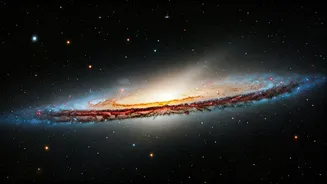
These particles travel in a straight line, offering a direct pointer back to their source. But when astronomers looked, the direction it came from seemed empty. The mystery deepened until researchers, using specialized telescopes, uncovered a galaxy so shrouded in dust that it was nearly invisible in normal light. This hidden object, officially named JCMT0402−0424, was so energetic despite its cloaked nature that scientists gave it a fitting nickname: the Shadow Blaster.
Einstein's Natural Telescope
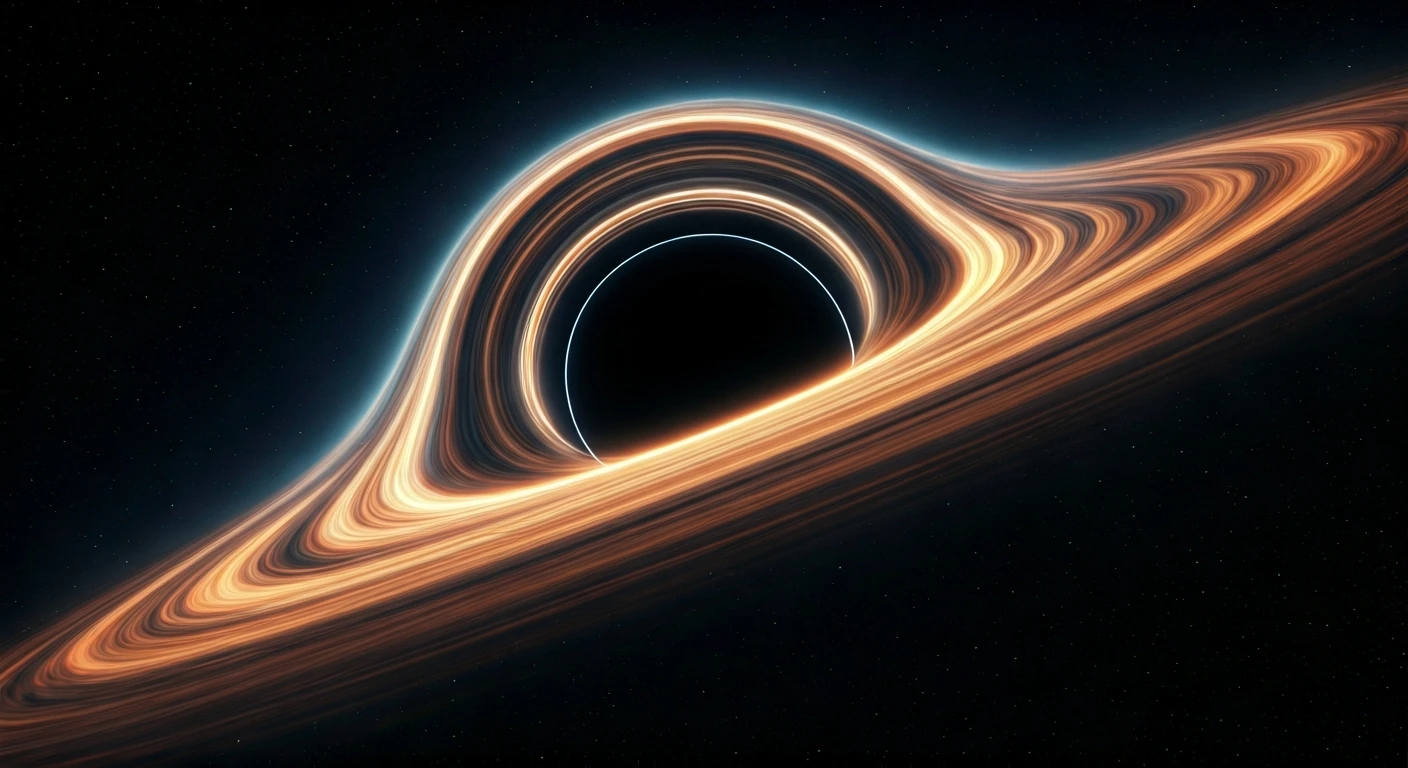
Getting a clear view of a galaxy so distant and obscured would normally be impossible. But astronomers had a cosmic ace up their sleeve: gravitational lensing. This phenomenon, first predicted by Albert Einstein, occurs when a massive object, like a galaxy or cluster of galaxies, sits in front of a more distant object. The immense gravity of the foreground object warps the fabric of spacetime, bending and magnifying the light from the background source, much like a glass lens focuses light. In this case, a massive elliptical galaxy sits directly between Earth and the Shadow Blaster, amplifying its light and splitting it into multiple distorted images. This natural telescope allowed facilities like the Atacama Large Millimeter/submillimeter Array (ALMA) to study the Shadow Blaster in remarkable detail.
Inside the Shadow Blaster
Initially, astronomers suspected the immense energy—and the neutrino—came from a supermassive black hole actively feeding at the galaxy's core, which is a common source of such phenomena. However, the detailed observations revealed no signs of an active black hole. Instead, they found something just as powerful: an extreme and violent burst of star formation. The Shadow Blaster is a 'starburst' galaxy, creating new stars at a furious pace. This process is happening within an incredibly compact and dense core, a region packed with gas and dust. It is this intense, chaotic environment—not a black hole—that is now believed to be the engine powering the particle acceleration that created the high-energy neutrino.
A New Kind of Cosmic Engine
This discovery marks a significant shift in understanding where the universe's most energetic particles come from. While active black holes have been linked to neutrinos before, they couldn't account for the total number detected by observatories. The confirmation of a starburst galaxy like the Shadow Blaster as a source provides the first major piece of evidence for a new type of cosmic engine. These dusty, star-forming galaxies were much more common in the early universe, when the cosmos was just a few billion years old. If many of these galaxies are capable of producing high-energy neutrinos, it could help explain the large, mysterious background of these ghost particles that scientists have long been trying to trace. The finding opens a new window into the most violent processes that shaped the universe in its youth.