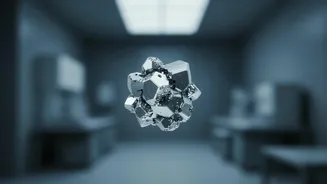








A Breakthrough in Materials Science
In the world of materials science, the discovery of a new alloy with unique properties is a significant event. Researchers have identified a novel material that pushes the boundaries of what we thought was possible. This isn't your standard steel or aluminum.
It's a complex, seven-element mixture classified as a high-entropy alloy (HEA), a relatively new class of materials that is changing how engineers think about strength, durability, and resilience. This discovery is a milestone in the quest for materials that can perform reliably under immense stress, promising to unlock new technological capabilities.
What Are High-Entropy Alloys?
For centuries, alloys were made using a simple recipe: take one primary metal, like iron or copper, and add small amounts of other elements to enhance its properties. High-entropy alloys flip this concept on its head. Instead of having one dominant element, HEAs are composed of five or more principal elements mixed in roughly equal proportions. This creates a unique atomic structure. The high degree of disorder, or 'entropy,' surprisingly results in a very stable and simple crystal structure, rather than a complex and brittle one. This structural stability gives HEAs exceptional properties, including superior strength, hardness, and resistance to wear and corrosion, far surpassing many traditional alloys.
Designed for the Extremes
The true promise of this new seven-element alloy lies in its ability to function under extreme conditions. Materials in environments like jet engine turbines, nuclear reactors, or deep-sea equipment are subjected to incredible pressures, corrosive chemicals, and scorching temperatures. Conventional alloys often fail, degrade, or lose their structural integrity in such harsh settings. High-entropy alloys, particularly refractory versions designed for heat, are built to withstand these challenges. Their unique atomic structure provides high thermal stability and strength even when pushed close to their melting points, making them ideal candidates for the next generation of high-performance technology.
From Lab to the Real World
While still in the development phase, the potential applications for this Hiroshima-born alloy and others like it are vast. In aerospace, it could lead to lighter, more fuel-efficient jet engines that can run hotter and faster. In the energy sector, such materials could dramatically improve the safety and efficiency of nuclear power plants by better containing radioactive materials under high-temperature conditions. Other potential uses include more durable tooling and cutting equipment, advanced protective coatings, and even biomedical implants that are highly resistant to corrosion within the human body. This alloy represents a foundational step toward creating components that last longer and perform better under pressure.
The Wider Context: A New Era of Alloy Design
This discovery is part of a broader shift in materials science. Instead of relying on accidental discoveries, scientists are now able to design materials from the ground up, predicting their properties using advanced computational models and quantum mechanics. This 'materials by design' approach allows researchers to create tailored alloys with specific characteristics for demanding applications. High-entropy alloys are at the forefront of this revolution. They represent a new paradigm where a vast, unexplored landscape of elemental combinations could yield materials with properties we have yet to imagine, solving some of the biggest engineering challenges of the 21st century.