







Not Fire, and Not a Rainbow
The captivating phenomenon highlighted in NASA’s latest image is one of the sky’s most beautiful illusions. Though its flame-like appearance has earned it the nickname "fire rainbow," the term is doubly misleading. Scientists know it by a more descriptive,
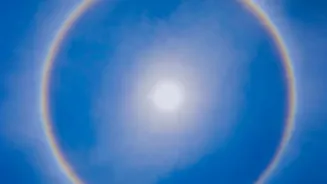
if less poetic, name: a circumhorizontal arc. It belongs to a family of optical phenomena called ice halos, which are created by the interaction of light with ice crystals suspended in the atmosphere. Unlike a true rainbow, which is formed by the refraction and reflection of light in liquid water droplets, a circumhorizontal arc owes its existence entirely to frozen crystals in high-altitude clouds. The name “fire rainbow” is a relatively recent term, apparently coined in 2006, likely because the arc can appear like a bright, colorful flame in the sky, especially when seen through patchy clouds.
The Three-Part Recipe for a Sky-High Illusion
Creating a circumhorizontal arc requires a precise atmospheric recipe with three key ingredients. First, you need high-altitude cirrus or cirrostratus clouds, which are found so high in the troposphere that they are composed of millions of tiny ice crystals instead of water droplets. Second, these ice crystals must be shaped like flat, hexagonal plates, and they need to be oriented horizontally as they drift through the air. Third, and most crucially, the sun must be very high in the sky. For the effect to occur, the sun’s elevation must be greater than 58 degrees above the horizon. When these conditions align, sunlight enters the vertical side of the plate-like crystals and exits through the horizontal bottom face. This 90-degree refraction acts like a prism, splitting the white light into its constituent colors and projecting a vibrant spectrum parallel to the horizon.
Why You Won't See One Everywhere
The strict requirement for a high sun angle is why circumhorizontal arcs are relatively rare and geographically limited. At latitudes above 55 degrees north or below 55 degrees south, the sun never gets high enough in the sky—even at the peak of summer—to produce the arc. This means skywatchers in places like the UK, Scandinavia, and the Canadian prairies have a much lower chance of ever seeing one. In mid-latitude regions, such as most of the United States and India, the phenomenon is most likely to be spotted during the summer months around midday, when the sun is at its highest point. For example, Los Angeles sees about 670 hours per year where the sun is high enough, whereas London only experiences 140 such hours. Even with the right sun angle, you still need the right kind of clouds to be present.
A Rainbow's Distant, Icy Cousin
While both are beautiful arcs of color in the sky, circumhorizontal arcs and rainbows are fundamentally different. A rainbow is formed by sunlight interacting with round, liquid raindrops. It always appears in the part of the sky opposite the sun. You see a rainbow when you stand with your back to the sun. A circumhorizontal arc, however, is formed by plate-like ice crystals and always appears on the same side of the sky as the sun, located about 46 degrees below it. The colors in a circumhorizontal arc are often purer and more distinctly separated than in a rainbow, appearing as a neat, spectral band with red on top. This phenomenon shouldn't be confused with cloud iridescence, either, which has more random, pastel-like colors and is caused by diffraction rather than refraction.
How to Spot This Rare Spectacle
If you live in the mid-latitudes and want to hunt for a fire rainbow, your best bet is to look up on a bright, sunny day during the summer. Pay attention during the hours around noon when the sun is highest. Look for thin, wispy cirrus clouds. These are the clouds that look like delicate white filaments or streaks high in the sky. The arc itself will be a broad, vibrant band of color running parallel to the horizon, well below the sun. Because of its position, you might need to block the sun with your hand to get a good look at the clouds below it. Sometimes, if the cloud cover is patchy, you may only see a fragment of the arc, but even a piece of it is an unforgettable sight.