







An Island Fortress by Design
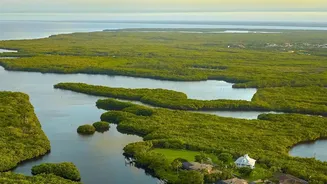
The value of Indian Creek begins with its geography. It is a man-made barrier island in Biscayne Bay, with a layout that seems engineered for isolation. The entire village, home to just a few dozen waterfront estates, is connected to the mainland by a single
bridge. This creates a natural chokepoint, and it is the only way in or out by car. There are no public streets, no sidewalks for tourists, and no commercial businesses. The interior of the island is occupied by an ultra-exclusive private golf course, with the 41 residential plots arranged around the shoreline. This design isn't an accident; it is the first layer of an almost impenetrable shield, ensuring that access is not a right but a strictly controlled privilege. For residents, this physical barrier is the foundation of the privacy they crave.
A Private Kingdom with a Private Police Force
Unlike other wealthy enclaves that rely on county services, Indian Creek is its own incorporated municipality. Established in 1939, the village has its own mayor, its own council, and, most importantly, its own dedicated police department. The Indian Creek Village Public Safety Department is a state-sworn police force whose sole jurisdiction is this tiny island. Their mission is not just to respond to incidents but to proactively “promote, preserve and deliver a feeling of security, safety and quality services” to residents. This includes 24/7 armed marine patrols that monitor the waters around the island, using radar and thermal cameras to deter any waterborne approaches. This level of governance gives residents total control over their environment in a way that is impossible in any other neighborhood. They aren't just buying a home; they are buying into a system designed entirely for their protection and discretion.
The Unquantifiable Value of Total Control
For residents like Jeff Bezos, Tom Brady, and Ivanka Trump, the price tag of an Indian Creek mansion is secondary to what it buys: absolute peace of mind. In a world where their every move is scrutinized, Indian Creek offers a sanctuary where variables are eliminated. Every visitor is screened at the guarded bridge checkpoint, turning access into a formal protocol. Deliveries, staff, and guests are all logged. This ecosystem of control extends beyond physical security. It creates a social moat. The community is self-selecting; potential buyers may even face screening by a homeowner's association. This ensures that every neighbor shares the same fundamental desire for discretion, preventing the kinds of conflicts or unwanted attention that can arise in less controlled environments.
Privacy as the Ultimate Luxury Asset
Ultimately, the value of Indian Creek is not just in its sprawling estates or waterfront views, but in the commodity it manufactures: perfect, unbreachable privacy. This privacy is a tangible asset that protects not just the residents' families but their wealth and reputations. In an era of constant connectivity and surveillance, the ability to disconnect completely is a rare and precious resource. Indian Creek has monetized this resource by creating a bubble where the outside world can be kept at bay. It's more than a neighborhood; it's a fortress-like service that high-profile individuals are willing to pay a massive premium for. The island represents a paradigm where security and exclusivity are not just amenities but the core product, making it one of the most valuable and sought-after locations for those who can afford it.