







Farewell to a Legend
For over two decades, the heart of every modern Bugatti has been the monumental 8.0-litre, quad-turbocharged W16 engine. This powerplant, a brainchild of former Volkswagen Group chairman Ferdinand Piëch, defined the hypercar segment, first in the Veyron
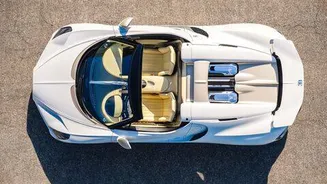
and then the Chiron. The final act for this iconic engine is the W16 Mistral, an open-top roadster with a production run limited to just 99 units. Recently, the last of these cars, a bespoke model finished in Pearl and Sparkle tones, rolled out of the Molsheim atelier, officially marking the end of the W16's road-going story. More than just a car, the Mistral was a celebration, a final, 1,578-horsepower roar from an engine that broke records and challenged the limits of engineering, including setting the world record for the fastest open-top production car at 282 mph.
The Challenge of Replacing an Icon
How do you replace an engine that has become a legend? The W16 wasn't just metal; it was Bugatti's identity. It powered the Veyron past 253 mph and the Chiron Super Sport 300+ beyond the mythical 300-mph barrier. The Mistral was the final, defiant statement of pure internal combustion supremacy. Any successor had to be more than just powerful; it needed to represent a new philosophy while respecting a legacy built on superlatives. The decision to move on from the W16, which began as a sketch on a Japanese bullet train, was not taken lightly. With the automotive world shifting towards electrification, Bugatti faced the challenge of innovating without losing the soul of the brand. The answer was not to abandon the internal combustion engine, but to reimagine it for a new era.
Enter the Tourbillon: A New Heart
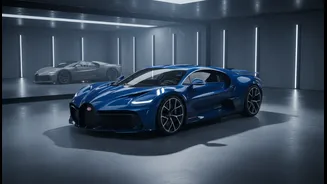
The successor has arrived, and it is called the Tourbillon. Named after a sophisticated watchmaking mechanism that enhances precision, the name itself signals a new focus on intricate, mechanical artistry. Bugatti has swapped the W16's quad-turbos for an entirely new, naturally aspirated 8.3-litre V16 engine developed with Cosworth. On its own, this engine produces a staggering 986 horsepower and revs to 9,000 rpm. But it doesn't work alone. It is paired with three electric motors—two on the front axle and one in the rear—that boost the total combined output to an astonishing 1,775 horsepower. This plug-in hybrid system is a radical step, allowing for an all-electric range of around 60 km while providing instant torque and power that even the W16 couldn't match.
Mechanical Artistry in a Digital Age
The Tourbillon represents a philosophical shift. While the Mistral was the ultimate expression of the W16, the Tourbillon is a completely new car from the ground up, sharing no components with its predecessor. This is the first entirely new design since Bugatti's merger with electric hypercar specialist Rimac. Inside, the commitment to analogue, tactile experiences is clear. Instead of digital screens, the driver is greeted by a skeletal gauge cluster of titanium and sapphire crystal glass, inspired by the finest Swiss watches. The V16 engine itself, weighing nearly half as much as the old W16, is a work of art designed to be an emotional centerpiece. Bugatti's goal was to create a car that would be considered timeless in 100 years, focusing on craftsmanship over fleeting digital trends.
The Future of the Hypercar
Priced at approximately $4.1 million before taxes and limited to just 250 units, the Tourbillon is hyper-exclusive. Its production will commence in a new dedicated facility, La Manufacture, as the W16 Mistral era officially concludes. This transition is more than just a model changeover; it’s a strategic pivot. By embracing a hybrid powertrain, Bugatti is future-proofing its brand, blending its legacy of extreme performance with the technological demands of the modern era. The end of the Mistral’s production is not a somber moment but a necessary one, clearing the factory floor and the company's focus for what is arguably its most ambitious project yet. The king is dead, long live the king.