




The Workhorse Rocket: Understanding the GSLV
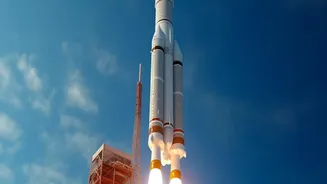
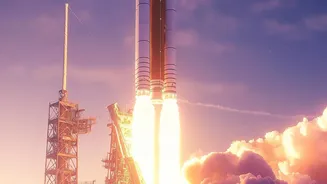
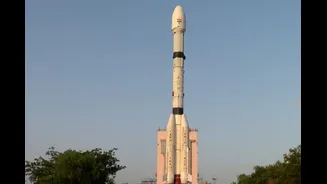
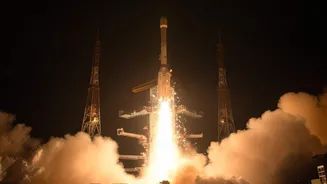
The star of the launch was the Geosynchronous Satellite Launch Vehicle (GSLV), a three-stage rocket that stands as a testament to India's self-reliance in space technology. Towering 51.7 metres tall with a lift-off mass of over 420 tonnes, the GSLV is
designed to carry heavier payloads into higher orbits. Its first stage uses a solid motor boosted by four liquid-fueled strap-on motors. The second stage is powered by a liquid engine, but the real marvel is the third stage: an indigenous cryogenic engine. This complex technology uses super-cooled liquid hydrogen and liquid oxygen as propellants, providing the immense thrust needed to place satellites into geosynchronous orbits, some 36,000 km above Earth. The GSLV-F17 mission was the 19th flight for the GSLV program, showcasing its growing reliability.
An Eye in the Sky: The EOS-05 Satellite
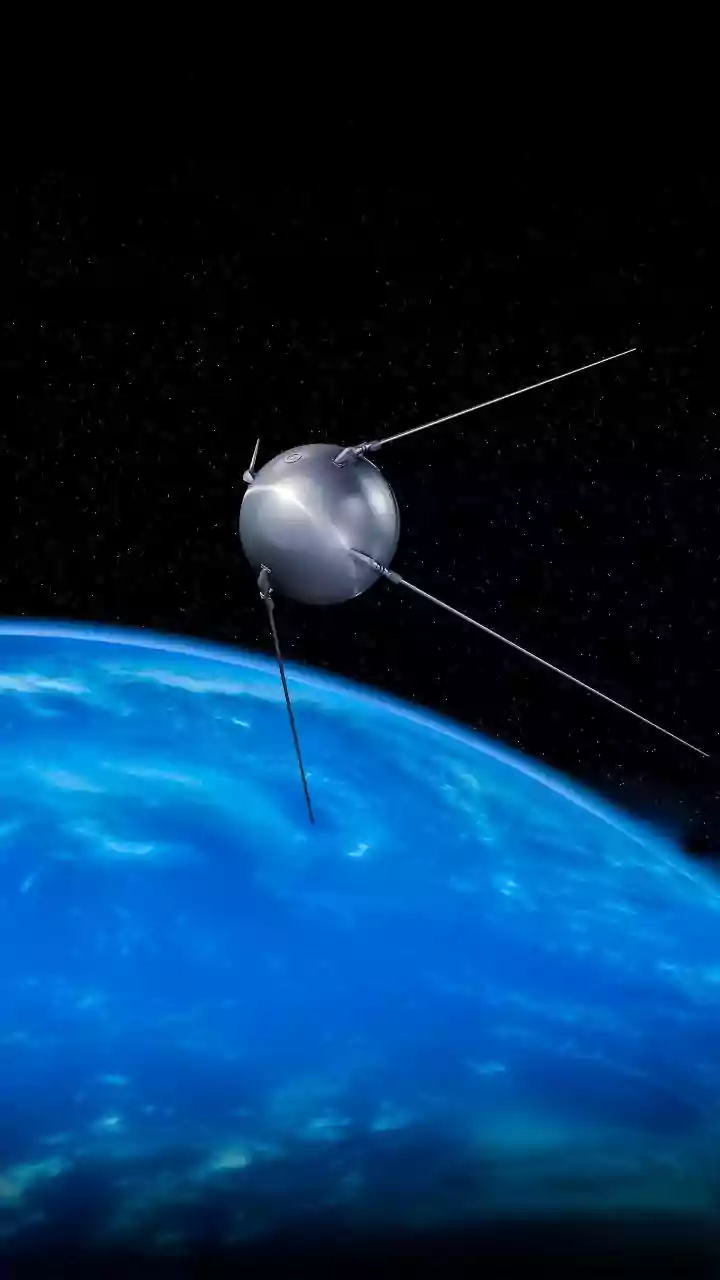
The precious cargo aboard this rocket was EOS-05, a state-of-the-art Earth-observation satellite. Weighing over 2,300 kg, it is one of the heaviest satellites launched by a GSLV. What makes EOS-05 particularly special is that it is India's first imaging satellite designed to operate from a geosynchronous orbit. Unlike most observation satellites that orbit at lower altitudes and pass over an area periodically, EOS-05 will remain in a fixed position relative to the Indian subcontinent. This unique vantage point will allow it to provide near-real-time, continuous monitoring of large geographical areas. From its high perch, it can image large sections of the Indian subcontinent every five minutes. This capability is expected to significantly boost India’s capacity in weather monitoring, disaster management, agricultural assessment, and strategic surveillance.
The Launchpad of Dreams: Sriharikota
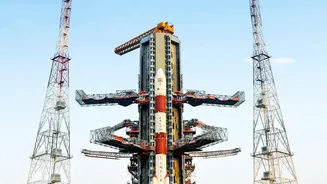
The entire operation unfolded at the Satish Dhawan Space Centre (SDSC) in Sriharikota, Andhra Pradesh, ISRO's primary spaceport. This spindle-shaped island on the Bay of Bengal coast was selected in 1969 for its ideal location. Its proximity to the equator provides an extra boost to rockets launching eastward, and the large, unpopulated area serves as a crucial safety zone. The first rocket, a small sounding rocket, was launched from here in 1971. Since then, the facility has grown into a world-class spaceport with multiple launch pads capable of handling rockets of all sizes, from the workhorse PSLV to the powerful GSLV. It is the nerve centre for every orbital launch India conducts.
A Landmark Mission: Why It Matters
The GSLV-F17/EOS-05 mission is significant for several reasons. Firstly, it marked ISRO's first successful launch of 2026, ending a seven-month gap and providing a morale boost. Secondly, by placing an imaging satellite in a geosynchronous orbit, India joins an exclusive club of nations with this capability, opening up new commercial and strategic opportunities. The mission successfully placed the satellite into a Sub-Geosynchronous Transfer Orbit (Sub-GTO). This is an intermediate, elliptical orbit that allows the rocket to conserve propellant. Over the coming days, the satellite will use its own onboard thrusters to perform a series of manoeuvres to raise and circularise its orbit, eventually settling into its final geostationary position. This success not only reinforces GSLV's role as a reliable launcher for heavy satellites but also paves the way for more ambitious future projects.