






A Flawless Ascent
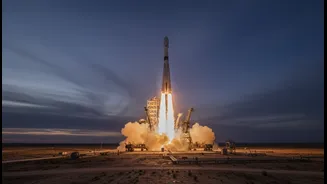
A Russian Soyuz rocket roared to life on Tuesday, July 14, carrying NASA astronaut Anil Menon and his two Roscosmos crewmates, Pyotr Dubrov and Anna Kikina, into orbit. The Soyuz MS-29 spacecraft lifted off precisely at 7:47 p.m. local time from the legendary
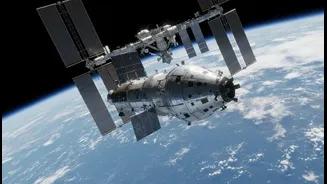
launch pad in Kazakhstan. Following a textbook-perfect ascent that lasted less than nine minutes, the spacecraft successfully separated from its third stage and began its automated, three-hour journey to the International Space Station (ISS). The crew docked with the orbiting laboratory while flying 260 miles above the Mediterranean Sea, a testament to the precision of modern space travel.
Anil Menon: An Indian-American Dream in Orbit
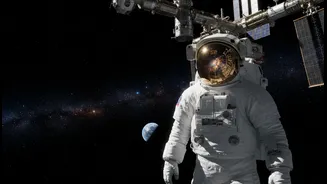
For Anil Menon, this launch represents the culmination of a remarkable journey. Born in Minnesota to a father from Kerala, India, and a mother from Ukraine, Menon's path to the stars was paved with a unique blend of medicine and military service. Before being selected as a NASA astronaut in 2021, he served as SpaceX's first-ever flight surgeon, helping to launch the company's first crewed mission. His career also includes time as a U.S. Space Force Colonel, an emergency physician, and a first responder to humanitarian crises in Haiti and Nepal. As a Rotary Ambassadorial Scholar, he spent a year in India supporting polio vaccination efforts, deepening his connection to his heritage. This eight-month mission is his first time in space, a moment of immense pride for the Indian diaspora worldwide.
Meet the Veteran Crewmates
Flying alongside Menon are two seasoned Russian cosmonauts. Mission Commander Pyotr Dubrov is on his second spaceflight, having previously completed a marathon 355-day mission aboard the ISS from 2021 to 2022. His extensive experience, which includes four spacewalks, makes him an ideal leader for the long-duration stay. Anna Kikina, also on her second mission, is the only active female cosmonaut in the Roscosmos corps. She previously flew to the station in 2022 aboard a SpaceX Crew Dragon, becoming the first Russian to fly on a private American spacecraft as part of a crew-swap agreement between NASA and Roscosmos.
A Busy Schedule Aboard the Station
Upon arriving at the ISS, the trio joined the seven astronauts and cosmonauts already on board, bringing the station's total crew to ten. Over the next eight months, Menon, Dubrov, and Kikina will work on a packed schedule of scientific research and technology demonstrations as part of Expeditions 74 and 75. Menon's tasks will include conducting medical research, such as using ultrasound with augmented reality to test new methods for remote medical support. He will also work on experiments to refine the production of semiconductor crystals in microgravity, which could have significant applications back on Earth. Their mission is expected to conclude in April 2027 with a return to Kazakhstan.
A Symbol of Continued Cooperation
This launch from Baikonur, a site steeped in space history, continues a legacy of international partnership that has defined the ISS program for over two decades. The station itself is a joint project between the space agencies of the U.S., Russia, Europe, Japan, and Canada. Despite geopolitical tensions on Earth, the collaboration in low-Earth orbit remains a powerful symbol of what can be achieved when nations work together toward a common goal. The sight of an American astronaut launching on a Russian rocket, alongside Russian cosmonauts, underscores the enduring professional and personal relationships that form the backbone of human space exploration.