


Our System’s Missing Planet
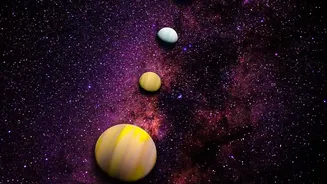
When we look out into the galaxy, astronomers have found that the most common type of planet is something our own solar system conspicuously lacks. These are the “super-Earths,” worlds with a mass greater than Earth's but considerably less than that of our ice
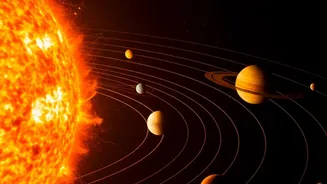
giants, Neptune and Uranus. They are everywhere we look, orbiting a huge number of stars similar to our sun. This raises a fascinating question: why are we the exception? Our planetary lineup jumps from small, terrestrial worlds like Earth and Mars directly to giants like Jupiter, which is over 300 times Earth's mass. There's nothing in between. For years, this gap has been a persistent puzzle for planetary scientists. Was our solar system simply unlucky in its formation, or is there a more dramatic story behind this missing planetary middle child? Several theories have been proposed, but a compelling new hypothesis suggests that our solar system wasn't always this way. In fact, it may have once hosted a super-Earth that played a pivotal role before being violently ejected.
The Ghost in the Machine
Recent computer simulations from leading research institutions are giving credence to the idea of a long-lost planet. Scientists are using sophisticated models to recreate the chaotic environment of the early solar system, a period when planets were still settling into their orbits within a dense disc of gas and dust. According to work by researchers at Caltech, a hypothetical super-Earth may have formed in the inner solar system billions of years ago. This isn't just a wild guess; the theory is based on running thousands of N-body simulations, a type of modelling that calculates the gravitational interactions between multiple objects. By adding a super-Earth into these simulations, scientists found that it could elegantly explain several odd features of our solar system that have long baffled them. The models suggest this primordial planet, several times more massive than Earth, was on a collision course not with another planet, but with the gravitational influence of the giants.
A Cosmic Billiards Game
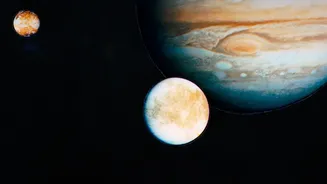
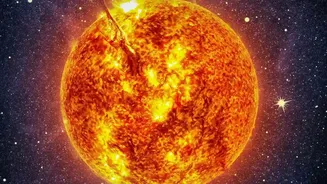
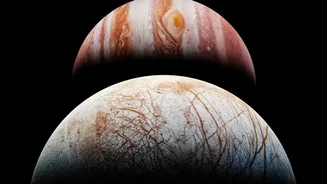
The leading theory, known as the “Grand Tack” hypothesis, proposes that Jupiter underwent a massive migration early in its history, moving closer to the sun before tacking back outwards to its current position, a journey influenced by the gravitational pull of Saturn. The presence of a super-Earth would have profoundly altered this cosmic dance. According to the simulations, as Jupiter moved inward, its immense gravity would have destabilized the orbit of this super-Earth. This event would have triggered a cascading series of collisions among smaller celestial bodies, known as planetesimals. This chaotic chain reaction could have driven the super-Earth into a decaying orbit, causing it and a cascade of other material to fall into the sun. In another scenario, the planet could have been flung into the outermost reaches of the solar system or ejected entirely into interstellar space by the combined gravitational might of the gas giants.
Solving Multiple Mysteries at Once
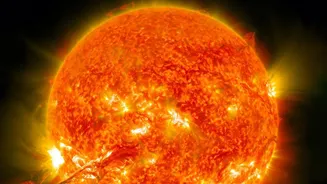
The beauty of this hypothesis is that it doesn't just explain the absence of a super-Earth; it potentially solves other puzzles, too. For instance, the terrestrial planets of our inner solar system—Mercury, Venus, Earth, and Mars—are surprisingly small and have lower masses compared to planets found in many other systems. The gravitational disruption caused by the migrating Jupiter and the ejected super-Earth would have cleared out much of the raw material from the inner solar system, effectively stunting the growth of the planets that formed there. Furthermore, a recent study suggests this chaotic event could also explain a chemical anomaly in our sun. If a super-Earth did indeed plunge into the young sun, it could have altered its chemical composition in ways that are still detectable, potentially accounting for certain stellar characteristics that don't fit standard models of solar evolution.
Could It Still Be Out There?
While many simulations suggest the planet was either destroyed or cast out into deep space, there is another tantalizing possibility. Some astronomers speculate that this ejected world might not have escaped the sun's gravity entirely. Instead, it could have been thrown into a vast, highly elongated orbit far beyond Neptune. This aligns with the separate, ongoing search for a theoretical “Planet Nine,” a massive planet believed to be shaping the strange orbits of distant objects in the Kuiper Belt. If the lost super-Earth is indeed Planet Nine, it would represent a stunning unification of two major astronomical theories. Finding this world would not only complete our solar system's planetary census but also provide direct evidence of the violent and unpredictable history that shaped our home in the cosmos.