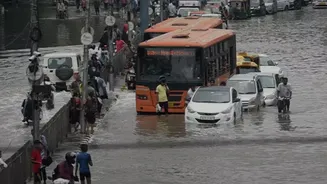









Why is the Rain So Intense?
This year's extreme rainfall follows a deficit in June and July. However, since the beginning of August, weather conditions have changed dramatically. The India Meteorological Department (IMD) has pointed to the impact of strong monsoon currents triggering
extremely heavy downpours, especially in the central and northern districts. In just the first four days of August, Kerala received 181% excess rainfall, recording 205.8 mm against a normal of 73.2 mm. This sudden, intense precipitation over a short period on already saturated ground is a primary driver of the flash floods and landslides being witnessed across the state.
Decoding the Colour-Coded Alerts
The IMD uses a colour-coded system to warn of impending severe weather. A 'Red Alert' is the highest level of warning and is issued when extremely heavy rainfall of over 20 cm in 24 hours is expected. On August 4th, the IMD issued a red alert for eight districts: Pathanamthitta, Kottayam, Idukki, Ernakulam, Kozhikode, Wayanad, Kannur, and Kasaragod. An 'Orange Alert' signifies a forecast of very heavy rain (11 cm to 20 cm), and a 'Yellow Alert' indicates heavy rain (6 cm to 11 cm). These alerts are crucial for state authorities to mobilize resources, issue evacuation orders, and prepare for emergencies. For today, August 6th, an orange alert is in effect for seven districts.
The Ground Situation: Evacuations and Relief
The relentless rain has forced a large-scale response from the state government and disaster management teams. As of August 5th, the death toll from rain-related incidents had risen to 28. So far, over 18,400 people have been shifted to 418 relief camps set up across the state. Districts like Pathanamthitta, Kottayam, and Alappuzha have seen the highest numbers of people moved to safety. In response to the crisis, seven teams from the National Disaster Response Force (NDRF), totaling 210 personnel, have been deployed for rescue and relief operations. These teams are active in the worst-affected areas, assisting local authorities with evacuations and providing aid.
Rivers and Dams Under Strain
The continuous downpour has caused several major rivers, including the Pamba, Manimala, and Meenachil, to swell and overflow their banks, inundating towns and low-lying areas. This has led to severe waterlogging, cutting off roads and access to villages. To manage the situation and prevent catastrophic dam failures, authorities are closely monitoring water levels in the state's reservoirs. While water levels in some major dams were under red alert status, officials have stated that overall storage in the main reservoirs remains well below panic levels, with most holding less than 50% of their capacity. Authorities have been opening spillway shutters in some places as a precautionary measure to safely discharge excess water.
A Recurring Challenge
For many in Kerala, the current floods bring back memories of the devastating deluge of 2018. Experts point out that while disaster response mechanisms and early warning systems have improved since then, the recurring nature of these events highlights ongoing challenges. The combination of a changing climate, leading to more frequent extreme weather events, and issues of land use and ecological degradation in sensitive areas like the Western Ghats continues to make the state vulnerable. The government and various agencies are engaged in not only immediate relief but also long-term strategies to build resilience against such disasters.