




What Is Sound, Really?
Every sound you've ever heard begins with a vibration. When a guitar string is plucked, a bell is rung, or you speak, you are causing something to vibrate. This vibration is a form of energy. The vibrating object pushes and pulls on the particles of the material
surrounding it, whether that's air, water, or a solid object. Think of it like a domino effect: the first particle moves and bumps into the next, which then bumps into the one after that, creating a chain reaction. This traveling disturbance is what we call a sound wave. It's not that the air particles from across the room travel all the way to your ear; instead, they pass the energy along in a wave. This is why sound is known as a mechanical wave—it needs a mechanical interaction between particles to move.
The All-Important Medium
The 'material' that sound travels through is called a medium. For us, the most common medium is air, but sound can travel through liquids and solids as well. In fact, it travels at different speeds depending on the medium. Sound moves fastest through solids, where particles are packed tightly together, slower through liquids, and slowest through gases like air, where particles are much more spread out. The closer the particles are to each other, the more efficiently they can pass the vibration along. Without a medium—without any particles to vibrate—the energy from the initial vibration has nowhere to go. It simply stops. A classic science experiment involves placing a ringing bell inside a glass jar and pumping all the air out. As the air is removed, the sound of the bell fades until it becomes completely silent, even though you can still see the hammer striking the bell.
The Emptiness of Space
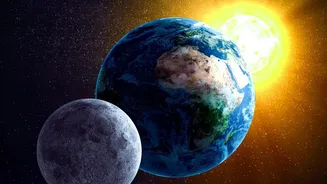
This brings us to space. The reason sound can't travel in space is that space is overwhelmingly a vacuum. A vacuum is defined as a space that is empty of matter. While it's not a 'perfect' vacuum—there are stray atoms and molecules floating around—the particles are incredibly far apart. On Earth, the air you're breathing is about 10 billion billion times denser than the matter in deep space. With particles so few and far between, there is no medium to carry the vibrations of a sound wave. An explosion, a collision, or a scream would all occur in total silence because there are not enough particles close enough to each other to start the chain reaction needed for sound to propagate.
How Astronauts and Satellites Communicate
If sound can't travel through a vacuum, how do astronauts talk to each other or to Mission Control on Earth? The answer lies in a different kind of wave: electromagnetic waves, such as radio waves. Unlike sound, electromagnetic waves do not need a medium to travel. They are self-propagating ripples of electric and magnetic energy that can travel perfectly through the vacuum of space at the speed of light. Astronauts' helmets are equipped with transmitters and receivers. When an astronaut speaks, a transmitter converts their sound waves into radio waves. These radio waves travel through the vacuum to the other astronaut's receiver, which converts them back into sound waves that can be heard inside their helmet. The same principle allows us to communicate with satellites and deep space probes across millions of kilometers.