




The Day the Solar System Shrank
For 76 years, Pluto was the quirky ninth planet at the edge of our solar system. Then, on August 24, 2006, the International Astronomical Union (IAU) voted to reclassify it. This decision, which sent ripples through classrooms and textbooks worldwide,
wasn't arbitrary. It stemmed from the discovery of other large objects in the outer solar system, like Eris, which was found to be even more massive than Pluto. Astronomers were faced with a choice: either add dozens of new planets to the roster or create a more precise definition of what a planet truly is. They chose the latter, establishing a new three-part test for planethood.
The Three Rules of Planethood
The IAU's 2006 resolution laid out three conditions a celestial body must meet to be considered a planet. First, it must be in orbit around the Sun. Second, it must have sufficient mass for its self-gravity to overcome rigid body forces, causing it to assume a nearly round shape (a state known as hydrostatic equilibrium). And third, it must have "cleared the neighbourhood" around its orbit, meaning it is the dominant gravitational force in its orbital path. It is this three-point checklist that sealed Pluto's fate, moving it into a new category called "dwarf planet."
First Test Passed: Orbiting the Sun
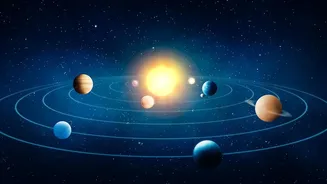
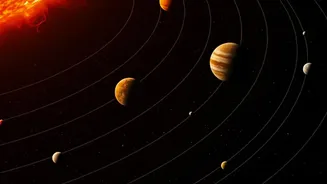
This is the easiest test to pass, and Pluto clears it with no problem. Discovered in 1930, Pluto follows a consistent, albeit highly elliptical, 248-year path around our Sun. It is unquestionably a member of our solar system, bound by the Sun's gravity. While its orbit is unusual, sometimes bringing it closer to the Sun than Neptune, it is a stable orbit. So, on the first criterion, Pluto gets a confident tick mark. This rule separates planets from moons, which orbit other planets.
Second Test Passed: Being (Mostly) Round
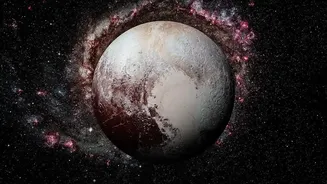
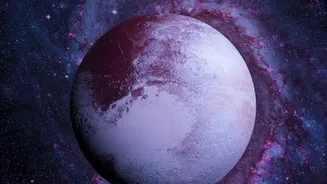
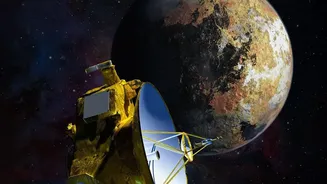
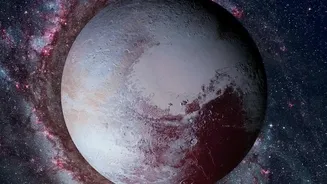
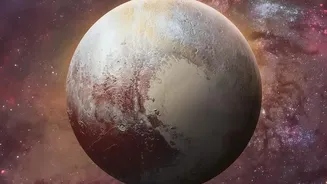
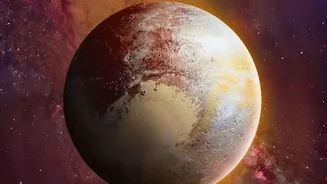
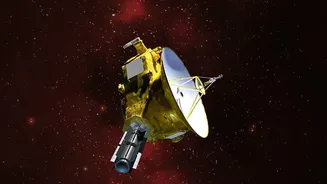
The second criterion is about shape, which is determined by mass and gravity. An object needs enough mass for its own gravity to pull it into a roughly spherical form. This is known as hydrostatic equilibrium. Smaller objects, like asteroids and comets, often have irregular, potato-like shapes because their gravity is too weak to mould them. Pluto, with a diameter of over 2,300 kilometres, is easily massive enough to have pulled itself into a sphere. Images from the New Horizons mission in 2015 confirmed its roundness, showing a complex and geologically active world. So, Pluto passes the second test as well.
The Failing Grade: Clearing the Neighbourhood
This is the hurdle where Pluto stumbles. "Clearing the neighbourhood" means a planet must be the gravitational boss of its orbit. Over billions of years, a planet will either absorb smaller objects in its path, capture them as moons, or fling them into different orbits. Earth, for instance, has a mass that is 1.7 million times the mass of all other objects in its orbital path combined. Pluto, by contrast, only accounts for about 7% of the mass in its own orbit. It resides in the Kuiper Belt, a crowded region of icy bodies beyond Neptune, and shares its space with thousands of other objects. Because it has not become gravitationally dominant, it fails this crucial third test.
A King in Its Own Category
Falling short of full planethood doesn't diminish Pluto's significance. The 2006 reclassification placed it as the founding member of a new and fascinating category: dwarf planets. These are worlds that meet the first two planetary criteria—they orbit the Sun and are round—but have not cleared their orbital neighbourhood. This group includes other intriguing bodies like Eris, the object that sparked the debate, and Ceres, the largest object in the asteroid belt. The demotion has, in many ways, elevated Pluto, making it the most famous example of a whole new class of celestial objects that are teaching us more about how our solar system formed.