



Our Galaxy's Quiet Giant
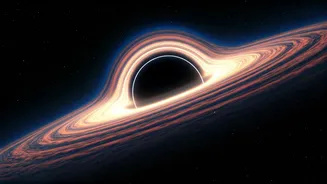
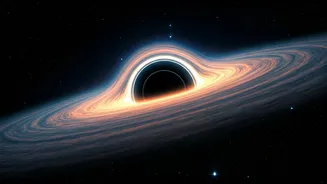
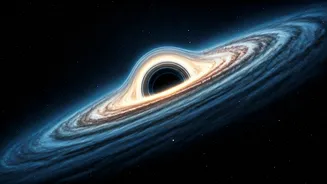
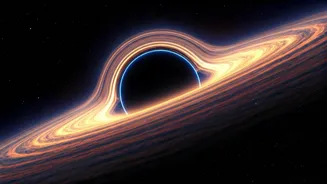
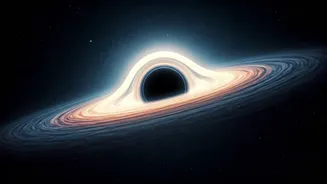
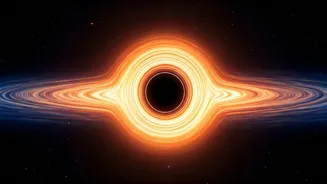
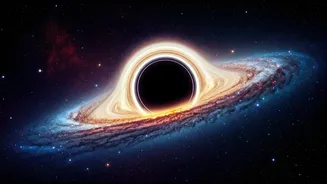
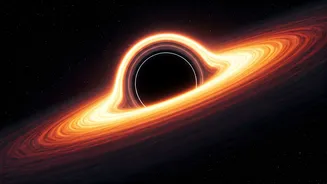
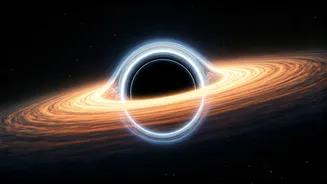
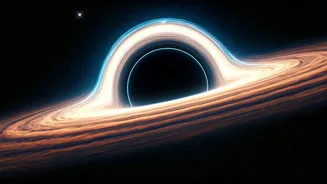
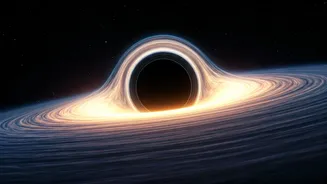
Every large galaxy, including our own, is thought to have a supermassive black hole at its center. Ours, Sagittarius A (or Sgr A for short), is a behemoth containing the mass of four million suns. For a long time, it has been considered relatively placid,
especially when compared to the violent black holes seen in other galaxies, known as active galactic nuclei (AGN), which visibly blast out enormous jets of matter across thousands of light-years. Sgr A is currently in a quiet phase, feeding very little and therefore releasing only small amounts of energy. However, astronomers have long suspected that even this quiet giant must interact with its environment, and that its past might be more active than its present suggests.
The Hunt for an Outflow
For decades, scientists have predicted that even quiet black holes should release some of the material they pull in, ejecting it back into space as either focused jets or wider winds. This process, known as 'feedback', is thought to be a crucial way that black holes regulate the growth of their host galaxies. Finding evidence of this from Sgr A, however, proved to be an immense challenge. The galactic center is a chaotic and crowded place, packed with stars, dust, and gas, making it difficult to detect a faint signal. Over the years, telescopes like NASA's Chandra X-ray Observatory found tantalizing hints of a weak, stubby jet, but the evidence remained inconclusive.
A Confirmed Cosmic Breeze
The breakthrough came from combining the power of different telescopes. Using X-ray data from the Chandra Observatory and radio observations from the Atacama Large Millimeter/submillimeter Array (ALMA) in Chile, astronomers finally found the smoking gun. The Chandra data revealed a cone-shaped cavity of hot, electrically charged gas extending out from the black hole. This structure was being carved out by a powerful outflow, or wind, emanating from Sgr A. The ALMA observations complemented this by showing how cooler gas clouds were being pushed and piled up along the boundaries of this expanding cone. After a 50-year search, the evidence was clear: our black hole is indeed breathing a cosmic wind out into the galaxy.
How to Reshape a Gas Cloud
So, how exactly does this wind 'shape' the nearby clouds? The effect is much like a cosmic leaf blower. This outflow, though faint by intergalactic standards, exerts a steady pressure on its surroundings. It plows into the vast, cool clouds of molecular gas that are the raw material for star formation. In doing so, it clears out a zone around the black hole while simultaneously compressing the gas it encounters. The clouds are literally being sculpted by this unseen force, pushed and reshaped into new forms. This process provides a direct link between the activity of the central black hole and the state of the interstellar medium hundreds of light-years away.
The Galaxy's Master Regulator
This discovery has profound implications for our understanding of the Milky Way. The interaction between the black hole's wind and the gas clouds isn't just about cosmic landscaping; it's a vital feedback loop that helps control star birth. By compressing gas in a cloud, the wind could trigger a collapse that leads to the formation of new stars. Conversely, by blowing the gas away entirely, it could starve a region of its star-forming potential, effectively quenching activity. This confirms that Sgr A* isn't just a passive resident of the galactic center but an active manager, regulating the pace of stellar evolution in its domain.