





A Historic Launch with a Twist
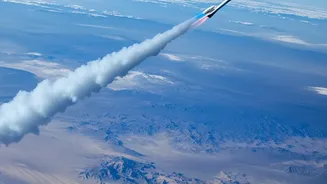
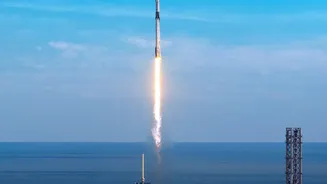
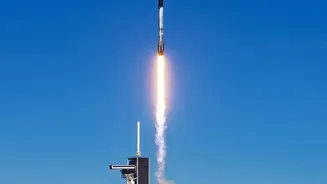
On Monday, September 28, the colossal Starship rocket lifted off from Starbase, Texas, marking its first-ever attempt to achieve a full orbit. The launch itself was a success, with the Super Heavy booster separating cleanly and splashing down in the Gulf
of Mexico as planned. The upper stage, known as Ship 41, then ignited its own engines to push toward orbit. However, shortly into this burn, one of its three powerful Raptor Vacuum engines shut down prematurely. This anomaly introduced a moment of high drama, forcing mission controllers into a rapid and critical decision-making process. Despite the glitch, the rocket had enough performance from its remaining engines to reach its target.
An In-Flight Decision
Initially, the premature engine shutdown seemed to put the primary mission goal in jeopardy. SpaceX's live broadcast commentator, Dan Huot, first announced that due to the failure, the rocket would not perform the final burn needed to enter a stable orbit. This would have relegated the flight to another suborbital test. However, after a tense 20-minute coasting phase where engineers frantically analyzed telemetry, a new call was made. The team determined that the remaining engines were healthy enough to not only place the ship into orbit but, crucially, to safely deorbit it later. With that confidence, SpaceX gave the 'go' for orbit, and Starship officially entered its planned trajectory around the Earth for the first time, a landmark achievement for the program.
A Shortened but Successful Mission
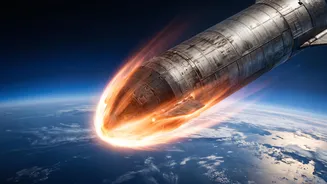
The original flight plan was ambitious: a nearly 10-hour mission that would see Starship circle the globe about six times. The primary goal was to deploy a batch of 26 operational Starlink V3 satellites, the first time Starship would deliver a working payload. Even with the engine issue, this objective was successfully met. However, out of an abundance of caution, SpaceX decided not to push its luck with the extended mission. Instead of the full 10 hours, the flight was shortened to just over three hours. The ship performed its deorbit burn after about two orbits and made a controlled splashdown in the Pacific Ocean, north of Hawaii. This demonstrated a key capability: even with a partial failure, the system could complete its main task and execute a safe return.
Why This 'Failure' Is a Win
For any other launch provider, an engine failure and a drastically shortened mission might be seen as a major setback. For SpaceX, it fits perfectly within its philosophy of rapid, iterative development. The company designs its rockets with significant redundancy—the Super Heavy booster, for instance, can lose several of its 33 engines and still complete its mission. The 14th flight proved that the upper stage also has a margin for error. By successfully reaching orbit, deploying its payload, and safely deorbiting despite an engine loss, Starship demonstrated a robustness that is critical for a reusable system intended to carry both cargo and, eventually, humans. Gathering data from these real-world anomalies is more valuable than a flawless flight, as it allows engineers to understand and fix the system's limits.
The Road Ahead for Starship
This flight marks the transition of Starship from a suborbital test vehicle to an operational, orbital-class spacecraft. The data gathered on the engine performance, heat shield survivability during reentry, and orbital operations is invaluable. The success of the mission, even in its truncated form, is a significant boost for SpaceX’s ambitions, which include building out its Starlink satellite internet constellation and developing the Human Landing System for NASA's Artemis program to return astronauts to the Moon. While the engine failure will need to be thoroughly investigated to determine if it was a one-off issue or a more systemic design flaw, the program can now move forward into a new phase of testing focused on long-duration flights and full reusability. The next major milestone will be attempting to catch the returning booster and ship with the launch tower's mechanical arms, a key step toward rapid and cost-effective reuse.