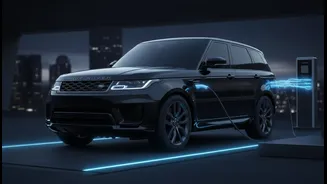









The Promise of a 15-Minute 'Refuel'
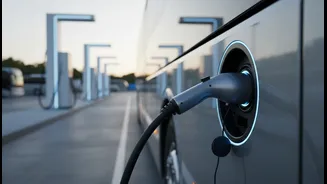
At the heart of the long-journey debate is charging time. For years, the biggest compromise of switching to electric has been the hours spent tethered to a charger on a road trip. The latest generation of 350kW DC ultra-fast chargers aims to demolish
this barrier. In ideal conditions, these powerful stations can add over 300 kilometres of range to a compatible luxury EV in as little as 15-20 minutes. This transforms the charging stop from a lengthy meal break into a quick coffee stop, making cross-country electric travel seem genuinely viable for the first time. The technology enabling this is a leap from the more common 400-volt systems to an 800-volt electrical architecture in the car itself. By doubling the voltage, manufacturers can deliver immense power to the battery with lower current, which drastically reduces heat—the primary enemy of fast charging. This allows the car to accept a firehose of energy safely and sustainably.
Not All Luxury EVs Can Drink from the Firehose
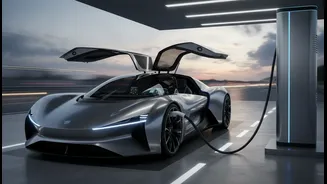
Having a 350kW charger nearby is only half the equation; the vehicle must be able to handle that power. Only a select group of high-end EVs, typically those built on an 800-volt platform, can take full advantage. Models like the Porsche Taycan, Audi e-tron GT, and the Hyundai Ioniq 5 have pioneered this technology. However, the number on the charger is a theoretical maximum, not a guarantee. Real-world charging speed is dictated by a car's 'charging curve'. This curve is influenced by the battery's temperature, its current level of charge (SoC), and its overall health. An EV will only hit its peak charging speed for a brief window, usually when the battery is nearly empty. As it fills up, typically past 80%, the charging speed slows down dramatically to protect the battery cells. So, while a Porsche Taycan might peak at over 300kW, its real advantage is its ability to maintain a high average charging speed for longer than its rivals.
The Hurdles: Battery Health and Grid Strain
This incredible speed is not without its trade-offs. While the occasional ultra-fast charge is harmless, some studies suggest that relying heavily on chargers delivering over 100kW can accelerate battery degradation. Recent data shows that frequent high-power DC charging could potentially double the annual rate of capacity loss compared to slower AC charging, from around 1.5% to 3% per year. This forces owners into a dilemma between convenience on the road and the long-term health of their vehicle's most expensive component. Beyond the car, the infrastructure itself presents a monumental challenge. A single 350kW charger can draw as much power as 50 to 70 houses combined. Deploying these at scale, especially along highways in remote areas, requires significant upgrades to the local electricity grid, which can be a slow and expensive process.
The Reality on Indian Highways
For luxury EV owners in India, the 350kW solution remains largely a future prospect. As of mid-2026, India's public charging network has grown significantly to over 25,000 stations, but the vast majority are slower AC chargers or DC fast chargers with a capacity of 50kW or less. The number of true ultra-fast chargers capable of 350kW is vanishingly small and confined to a few select locations in metro cities. The charging infrastructure is heavily concentrated in cities like Delhi, Mumbai, and Bengaluru, and along a few key expressways like the Mumbai-Pune or Delhi-Jaipur routes. Even on these better-served routes, drivers often contend with charger unreliability and high traffic, with India's EV-to-charger ratio standing at a challenging 235:1, far from the global benchmark of around 15:1. For the owner of a large luxury EV, finding a charger is one thing; finding one that can maximize their car's advanced charging capability is another challenge entirely.