






A Cosmic Wanderer
Deep in space, about 4.5 billion light-years from Earth, astronomers have identified a peculiar object named XJ1417+52. While most large galaxies have a supermassive black hole securely anchored at their core, this one is different. It’s located on the outskirts
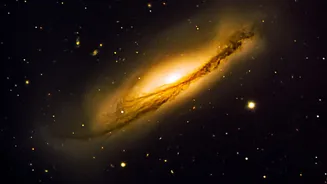
of its host galaxy, a lenticular galaxy known as GJ1417+52. This immediately flags it as an oddity. The rules of galactic formation suggest these gravitational behemoths should reside at the center, growing by consuming gas, dust, and stars. Finding one so far out in the galactic suburbs is like discovering a city's central business district has somehow been relocated to a quiet residential street. This discovery challenges our neat models and forces scientists to ask a fundamental question: how did it get there?
The Prime Suspect: Galactic Collision
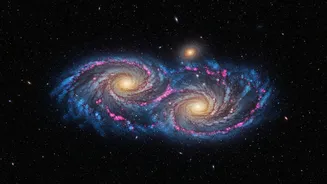
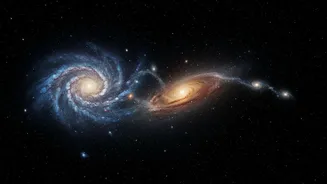
The leading theory for how a black hole ends up wandering is a dramatic one: a galactic merger. Scientists believe that XJ1417+52 was once the central black hole of a much smaller, dwarf galaxy. In a classic case of cosmic bullying, this smaller galaxy collided with the larger GJ1417+52. During this violent encounter, the larger galaxy's immense gravity would have stripped away most of the smaller galaxy's stars and gas. However, the dense, compact black hole at its heart would have survived the collision, left to roam the outer regions of its new, larger host. The discovery of this off-center black hole provides compelling evidence for this model of galactic evolution, showing the chaotic and dynamic processes that shape the universe over billions of years.
NASA's Swift and the Multi-Wavelength View
The headline's reference to the 'Swift' observatory is key. While initial observations of this object came from NASA's Chandra X-ray Observatory and the ESA's XMM-Newton, the Neil Gehrels Swift Observatory plays a crucial role in understanding such phenomena. Swift is a unique, multi-wavelength space observatory designed to rapidly respond to high-energy events like gamma-ray bursts. It is equipped with instruments that can observe in gamma-ray, X-ray, ultraviolet, and optical light. This ability to see across the spectrum is vital. For wandering black holes, which are typically invisible, their presence is often revealed only when they consume a passing star—an event known as a tidal disruption event (TDE). These events flare up brightly, and Swift’s rapid-response capability and multi-wavelength view allow astronomers to capture the event's light curve, temperature, and evolution, providing clues to the black hole's mass and environment.
An Unusually Bright Meal
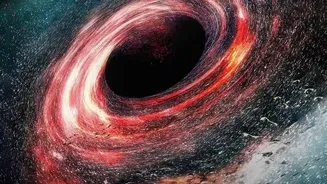
What made XJ1417+52 stand out was its extreme brightness. At its peak, the X-ray emissions from the black hole were about 10 times more luminous than any other wandering black hole previously seen, classifying it as a 'hyper-luminous X-ray source'. This intense flare-up, which peaked between 2000 and 2002, is believed to have been caused by a star that strayed too close and was torn apart by the black hole's immense gravity. The material from the shredded star formed a super-heated accretion disk around the black hole, radiating the massive amounts of X-rays that telescopes like Chandra and XMM-Newton detected. This made the otherwise hidden black hole, estimated to have a mass of about 100,000 times that of our sun, temporarily one of the brightest objects in the sky at X-ray wavelengths.