



A Marathon of Millennia, Not Minutes
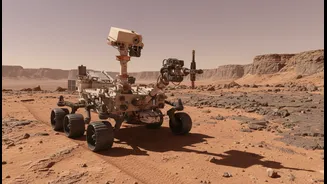
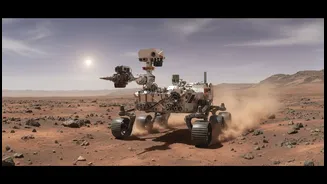
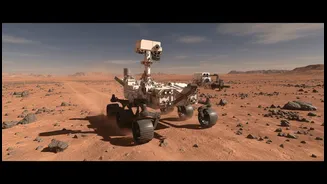
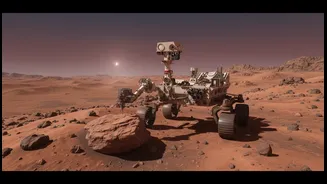
On June 14, 2026, after five years and four months of painstakingly navigating the treacherous Martian landscape, the Perseverance rover officially crossed the marathon mark. This wasn't a race against time, but a testament to endurance. Unlike a human
marathoner who might finish in a few hours, Perseverance’s journey was a slow, deliberate crawl punctuated by complex scientific investigations. Each metre covered represents years of planning by engineers and scientists back on Earth. Perseverance is only the second rover to achieve this milestone on another world. The first was its predecessor, the Opportunity rover, which took a staggering 11 years and two months to cover the same distance. Perseverance’s much faster time highlights a leap forward in robotic exploration technology, particularly its advanced autonomous navigation system, which allows it to assess terrain and make driving decisions on its own.
The Toughest Course in the Solar System

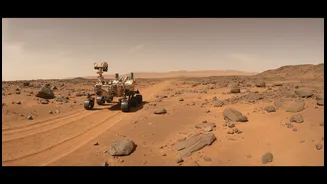
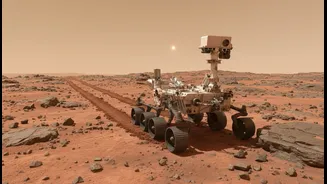
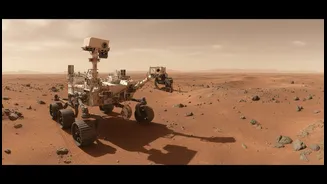
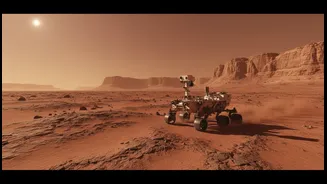
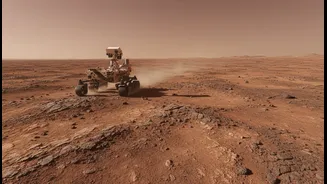
The course for this marathon was not a paved city street but the rugged floor of Jezero Crater. This 45-kilometre-wide basin, chosen for its potential to hold signs of ancient life, is a minefield of hazards. The rover has had to contend with sharp rocks that could shred its wheels, deep sand traps that could ensnare it forever, and steep crater walls that test its climbing ability. The day before hitting the marathon distance, NASA’s Mars Reconnaissance Orbiter captured a stunning image of the rover—a tiny speck against the vast, rust-colored expanse, with its long, winding tracks telling the story of its journey through a region the team has nicknamed 'Arbot'.
More Than a Drive, A Journey of Discovery
This marathon wasn’t just about covering ground; it was about rewriting our understanding of Mars. Since landing in February 2021, Perseverance's primary mission has been astrobiology—searching for evidence that microbial life may have once existed on the Red Planet. The rover began by exploring the crater floor before ascending the magnificent, fan-shaped remnant of an ancient river delta. It was here, among layers of sedimentary rock deposited by water billions of years ago, that Perseverance began drilling and collecting its core samples. These samples, hermetically sealed in tubes, are the first part of an ambitious international plan to one day return Martian rocks to Earth for detailed study.
Science at Every Stop
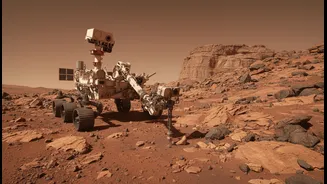
Along its 42-kilometre path, the rover has acted as a robotic field geologist. It has studied rocks that tell a story of a geologically complex past, with evidence of both volcanic activity and a sustained period where liquid water flowed into a lake. By venturing west of the main crater, Perseverance is now examining some of the oldest rocks accessible during its mission, offering a window into an even earlier period of Martian history. These scientific pit stops are the real purpose of the mission. The driving is merely the commute to the next great outdoor office, where the rover uses a suite of instruments to analyze mineralogy and search for the chemical building blocks of life.
The Next Leg of the Race
Crossing the marathon finish line is a celebrated milestone, but the race isn't over. Perseverance is still in excellent health and continues to push the boundaries of exploration. The next major record in its sights is the all-time off-world driving distance title, currently held by the Opportunity rover at 45.16 kilometres. With less than three kilometres to go, Perseverance is poised to become the undisputed long-distance champion of extraterrestrial driving. Every new metre it travels takes humanity into uncharted territory, gathering more data and collecting more samples that could one day answer one of our oldest questions: were we ever alone in the universe?