






From Entirely Different Plant Families
The most significant difference lies in their botanical origins. Regular potatoes (Solanum tuberosum) are members of the nightshade family, Solanaceae. This makes them relatives of tomatoes, peppers, and eggplants. In contrast, sweet potatoes (Ipomoea
batatas) belong to the Convolvulaceae family, more commonly known as the morning glory family. Their evolutionary paths diverged millions of years ago, and their similarities are a case of convergent evolution rather than a close family tie. This fundamental genetic separation is the root of all their other differences, from how they grow to their nutritional makeup.
What Part of the Plant Are We Eating?
While both grow underground, the part of the plant we harvest and eat is botanically distinct. A regular potato is a 'stem tuber'. It's a swollen, modified part of the plant's stem that grows underground. The 'eyes' on a potato are actually nodes that can sprout and grow into new plants. A sweet potato, however, is a 'storage root'. It is a modified root that swells to store energy for the plant. Unlike a stem tuber, it doesn't have eyes and grows from 'slips', which are shoots from the parent root. This makes a sweet potato a true root vegetable, while a potato is technically a stem.
A Tale of Two Nutritional Profiles
Often debated for their health benefits, both vegetables are nutritious but excel in different areas. The most dramatic difference is in Vitamin A. Sweet potatoes, especially the orange-fleshed varieties, are packed with beta-carotene, which the body converts into Vitamin A. A single serving can provide well over 100% of the daily recommended intake. Regular white potatoes contain almost no Vitamin A. On the other hand, white potatoes typically offer more potassium and slightly more protein than sweet potatoes of a similar size. Calorie and carbohydrate counts are broadly similar, though this can vary with cooking methods. Sweet potatoes tend to have more fibre and natural sugars, while potatoes are starchier.
Different Behaviours in the Kitchen
These botanical and nutritional differences translate directly to the kitchen. The higher sugar content in sweet potatoes means they caramelize beautifully when roasted and offer a distinctly sweet flavour. They also contain an enzyme that breaks down starches into sugar during cooking, enhancing their sweetness. Their texture is often creamier and moister. Regular potatoes are starchier and have a more neutral, earthy flavour, making them incredibly versatile. Their fluffy, absorbent texture when baked or boiled makes them a perfect vehicle for butter, herbs, and other toppings. While you can often substitute one for the other, the results in texture and taste will be noticeably different.
Don't Forget About Yams
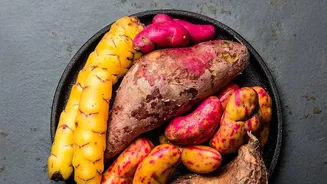
To add another layer of confusion, what are often labelled 'yams' in Indian and many American supermarkets are actually just a different variety of sweet potato, usually one with orange flesh and copper skin. True yams belong to yet another botanical family (Dioscoreaceae) and are native to Africa and Asia. They are starchier, drier, and have a rough, bark-like skin, bearing little resemblance to the sweet, smooth-skinned sweet potato. The mislabelling is a historical marketing quirk that has persisted for decades.