






What Are These New Electric Planes?
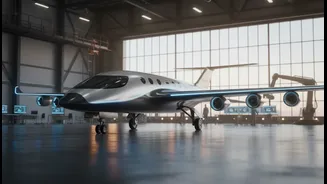
Imagine a quieter, cleaner flight for your next short-haul trip. That's the vision behind a new generation of aircraft being developed by companies like Heart Aerospace. Their flagship design, the ES-30, is a 30-seat regional airplane that embodies this
new approach. Rather than relying solely on traditional jet fuel, it uses a hybrid-electric system. For shorter routes, of around 200 kilometres, it can fly on battery power alone with zero emissions. For longer journeys, a reserve of sustainable aviation fuel kicks in to power onboard generators, extending its range to 400 kilometres or more. This hybrid model is seen as a crucial stepping stone, bridging the gap between today's technology and a fully electric future. It allows airlines to reduce their carbon footprint significantly without waiting for the breakthroughs in battery technology needed for long-haul electric flight.
The Promise of Greener Skies
The appeal of hybrid-electric aircraft is clear. They promise substantially lower operating costs, reduced noise pollution around airports, and a dramatic cut in carbon emissions. For regional airlines, which often operate on thin margins, these benefits could be transformative. The ability to fly into smaller airports with strict noise regulations opens up new potential routes, enhancing connectivity for passengers. Airlines like Air Canada, United Airlines, and SAS have already placed hundreds of orders and letters of intent for these types of aircraft, signaling strong industry confidence in their potential. The goal for many is to begin offering passenger flights on these new planes by 2028, a target that has generated both excitement and considerable debate.
The Billion-Rupee Question: Battery Power
The single greatest obstacle to electric aviation is the battery. Jet fuel is incredibly energy-dense, packing about 12,000 watt-hours (Wh) per kilogram. Today's best lithium-ion batteries hold around 250-300 Wh/kg. Even though electric motors are far more efficient than jet engines, a huge gap remains. To power a commercial aircraft, batteries need to be not just powerful, but also lightweight, durable, and exceptionally safe. Researchers are working on next-generation solutions like lithium-sulfur or solid-state batteries, which promise higher energy densities of 400-600 Wh/kg. Some companies, like CATL, have even announced 'condensed batteries' aiming for 500 Wh/kg, which they hope to deploy on an 8-ton aircraft by 2028. However, these advanced technologies are still largely in development and face their own challenges, from limited cycle life to manufacturing scale.
The Regulatory Hurdle
Building an innovative aircraft is one thing; getting it certified to fly commercially is another. Aviation regulators like the US Federal Aviation Administration (FAA) and the European Union Aviation Safety Agency (EASA) have some of the strictest safety standards in the world. Certifying a novel propulsion system that combines electric motors, batteries, and traditional engines is a complex, expensive, and time-consuming process. These agencies are still developing the exact frameworks for how to approach these new designs. Manufacturers must prove that their aircraft are safe under all possible failure conditions, a task made more complicated by the introduction of high-voltage electrical systems and complex control software. Some in the industry have noted that a lack of specific regulations and limited regulator expertise in electric propulsion are significant challenges to meeting a 2028 service entry date.