









A Critical Step on the Ground
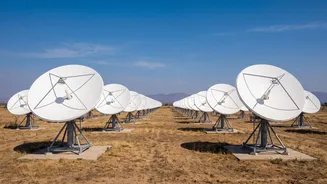
In a significant move that signals tangible progress, SpaceX executive Lauren Dreyer confirmed at the India Mobile Congress 2026 that Starlink has built 20 gateway sites, or ground stations, across India. This is not just a plan on paper; it represents
a serious capital investment and the creation of the physical backbone necessary to connect its satellite constellation to the terrestrial internet. These ground stations, which feature hundreds of antennas, are the crucial link that relays data from the satellites in low-Earth orbit to the global web and back to the user's dish. By building this infrastructure, Starlink is signaling to both the government and the market that it is ready to flip the switch as soon as the final regulatory permissions are granted. The company has emphasized that these operations are designed specifically for India, with a commitment to keeping all Indian user data within the country to comply with national security requirements.
How Satellite Internet Connects India
For many, the term 'satellite internet' might bring to mind the slow, laggy connections of the past. Starlink, however, operates differently. It uses a massive constellation of thousands of Low Earth Orbit (LEO) satellites that fly much closer to the planet—around 550 km high—than traditional geostationary satellites. This proximity drastically reduces latency, making the service feel more like high-speed fibre broadband, capable of supporting streaming, online gaming, and video calls. The system is designed to provide coverage anywhere with a clear view of the sky, making it a potential game-changer for India's rural and remote areas where terrestrial fibre and mobile towers are difficult and expensive to deploy. According to some estimates, thousands of villages in India still lack 4G coverage, a gap that satellite services are uniquely positioned to fill.
Navigating India's Regulatory Web
While the ground stations are ready, the path to a commercial launch is paved with regulatory processes. Starlink secured two key approvals in 2025: a Global Mobile Personal Communication by Satellite (GMPCS) licence from the Department of Telecommunications (DoT) and an authorisation from the Indian National Space Promotion and Authorisation Centre (IN-SPACe) for its first-generation satellite network. However, several critical hurdles remain. The most significant are the final security clearances and the formal allocation of spectrum. India's government has stringent security requirements for communication networks, influenced by historical events like the use of satellite phones in the 26/11 attacks. This has led to a cautious approach, with authorities insisting that all network traffic can be lawfully monitored on Indian soil. Furthermore, the method of spectrum allocation—whether by auction or administrative assignment—has been a point of contention among industry players, though the government now appears to be favoring the latter.
The Race to Rule the Skies
Starlink is not entering an empty field. The race for India's satellite internet market is heating up, with formidable competitors also waiting in the wings. Eutelsat OneWeb, backed by Indian telecom giant Bharti Group, and Reliance's JioSpaceFiber, a venture with satellite operator SES, have also received their GMPCS licenses and are preparing for launch. OneWeb actually received its IN-SPACe approval before Starlink and has its own ground stations in Gujarat and Tamil Nadu. Jio, a dominant force in terrestrial broadband, has already demonstrated its satellite capabilities in remote locations. This competitive pressure recently boiled over when Elon Musk posted on X, alleging that 'certain oligarchs' were trying to block Starlink's entry to protect their 'monopolistic chokehold'—a thinly veiled reference to his domestic rivals. The competition is expected to be fierce, likely leading to competitive pricing strategies to win over India's price-sensitive consumers.
The Path to Your Rooftop
For the average consumer wondering when they can order a Starlink kit, the answer remains 'soon, but not yet'. A launch in early 2027 is seen as possible, but it is entirely contingent on the government issuing the final clearances. Once approved, the service will involve a one-time hardware cost for a small satellite dish—the user terminal—and a monthly subscription fee. While official Indian pricing hasn't been announced, figures that briefly appeared on its website in late 2025 were dismissed as a technical glitch. Analysts expect pricing to be competitive, potentially falling in the range of ₹2,500 to ₹3,500 per month, though introductory offers from all players could be aggressive. The true promise of Starlink and its competitors lies in their ability to finally bridge India's digital divide, bringing reliable, high-speed internet to every corner of the country, from the Himalayas to the backwaters of Kerala.