

What Does a 'Quieter' Galaxy Mean?
In the vastness of space, 'quiet' isn't about sound. Since space is a near-perfect vacuum, sound waves have no medium to travel through. Instead, when astronomers say a galaxy is growing quieter, they are referring to a decline in its star formation rate.
Galaxies are cosmic nurseries, vast collections of gas and dust where new stars are born. A 'loud' or active galaxy is one that is vigorously converting its raw materials into bright, new stars. A 'quiet' one, by contrast, has seen its production slow, marking a transition from a vibrant, youthful state to a more sedate, middle-aged existence.
The Evidence From Hubble's Fossil Record
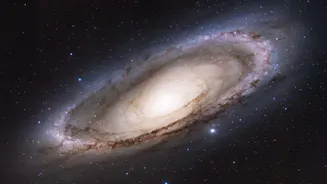
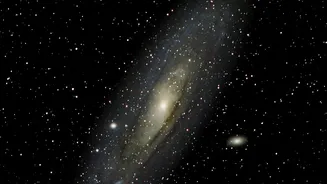
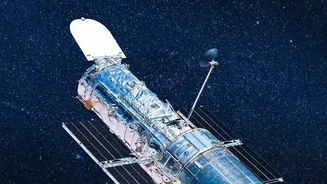
The latest findings come from a deep dive into archival data from NASA's Hubble Space Telescope. By mapping approximately two-thirds of Andromeda's disk, astronomers were able to analyze nearly 200 million individual stars. According to Ben Williams, an astronomer at the University of Washington, these stars serve as a 'fossil record' of the galaxy's history. Massive stars burn hot and blue but have short lifespans, so their presence signals recent star birth. Less massive, redder stars live much longer and point to older populations. By analyzing the color and distribution of these stars, scientists created a detailed timeline of Andromeda's activity.
Andromeda's Roaring Past and Fading Present
The data paints a picture of a galaxy that is winding down. About two billion years ago, Andromeda experienced a dramatic burst of star formation, likely triggered by a merger with a smaller galaxy. But that boom period is long over. The new analysis shows that for the past 500 million years, star formation has been steadily declining. Around that time, Andromeda was creating stars at a rate of about one solar mass (the mass of our Sun) per year. By 40 million years ago, that rate had been cut in half, and today, it has plummeted to just one-fifth of a solar mass per year.
Why Is the Fire Going Out?
Interestingly, Andromeda isn't running out of fuel. There's still plenty of gas and dust available to form new stars. Instead, the slowdown appears to be a natural winding-down process after its earlier, more frantic era of star birth. Much of the galaxy's remaining star formation is now concentrated in a ring about 32,000 light-years from its center, and even that area is becoming less active. Scientists also suspect a small satellite galaxy, M32, may have played a role. Evidence suggests M32 may have plunged through Andromeda's disk around 60 million years ago, disrupting gas clouds and contributing to the slowdown in a specific area.
A Glimpse into the Milky Way's Future
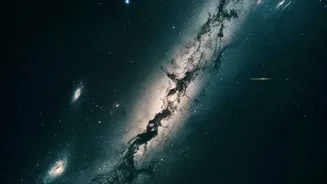
As Andromeda is a spiral galaxy similar in size to our own Milky Way, studying its life cycle offers a preview of what might lie ahead for us. Galaxies, like stars and people, have a finite period of activity before they settle into a quieter old age. By observing Andromeda's transition, we gain crucial insights into the long-term evolution of large galaxies. This helps astronomers refine their models for how galaxies form, grow, and eventually fade, providing a more complete picture of the cosmic environment in which we live.
The Coming Collision
Andromeda's slowing star production is also the backdrop for a much more dramatic future event: a colossal collision with our own Milky Way galaxy. The two galaxies are hurtling toward each other and are predicted to merge in about 4.5 billion years. Because Andromeda is already in a quiescent state, this merger might not trigger the massive burst of star formation typically seen when two gas-rich galaxies collide. The eventual result will be the birth of a new, giant elliptical galaxy—nicknamed 'Milkomeda'—formed from the combined stars, dust, and gas of its two parents. For any observers billions of years from now, the night sky will be irrevocably transformed.