
Where We Thought the Edge Was
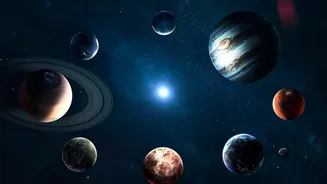
To understand how big this new idea is, we first need to look at the old one. For years, scientists have had two main ways of defining our solar system's boundary. The first is the heliopause. Think of it as a cosmic weather front. Our Sun constantly
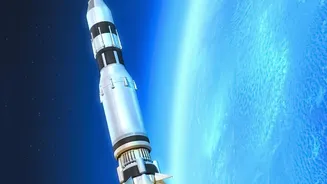
emits a stream of charged particles called the solar wind, which travels billions of kilometres in every direction, creating a protective bubble called the heliosphere. The heliopause is the point where this solar wind is no longer strong enough to push back the wind from other stars in interstellar space. NASA's Voyager 1 and 2 spacecraft crossed this boundary at around 120 astronomical units (AU) from the Sun, with one AU being the distance from the Earth to the Sun. The other, much larger boundary is the Oort Cloud, a theoretical, immense sphere of icy bodies surrounding the Sun. It's believed to be the source of many comets and extends up to 100,000 AU, or about 1.6 light-years away.
A New Gravitational Map
Now, a new theory is challenging these definitions. In a paper published in the 'ROOM - The Space Journal of Asgardia', former NASA chief scientist Jim Green and mathematician Ed Belbruno of Yeshiva University argue that the true boundary isn't about solar wind, but about gravity. Their proposal suggests that the edge of the solar system should be defined as the point where the Sun's gravitational pull is finally overcome by the gravitational forces of the entire Milky Way galaxy, including the mysterious influence of dark matter. Instead of a neat line, they describe this frontier as a fuzzy, dynamic area governed by a 'complex dance among forces, energies and trajectories'. This shifts the definition from a boundary of 'weather' to a boundary of fundamental influence.
So, How Much Bigger Are We?
The change proposed by Green and Belbruno is staggering. While the heliopause is at about 120 AU, and the far edge of the Oort Cloud is estimated at 100,000 AU, their gravitational boundary would extend to roughly 241,000 AU. That translates to nearly 3.8 light-years from the Sun. To put that into perspective, the nearest known star to our sun, Proxima Centauri, is about 4.2 light-years away. This new definition would mean our solar system's gravitational territory extends nearly halfway to our closest stellar neighbour. Our cosmic backyard, in essence, would be more than twice as large as the already vast region defined by the Oort Cloud. This redefines our local space to be on the same scale as the distances between stars themselves.
Cosmic Gateways and Rogue Planets
This redefinition isn't just an academic exercise; it has fascinating implications. The researchers suggest that within this vast gravitational zone, there are stable points known as Lagrange points, created by the interaction between the Sun's gravity and the galaxy's. These points could act as 'portals' or pathways, gently capturing slow-moving interstellar objects that drift by. According to Green, this means objects from beyond our solar system, perhaps even large 'rogue planets' that roam the galaxy untethered to a star, could be captured and become permanent members of our solar system. The theory provides a new framework for understanding how interstellar visitors arrive and opens up exciting possibilities for what might be lurking in the far reaches of the Sun's influence. Green is even in discussions with the team managing the New Horizons spacecraft, which is currently in the outer solar system, to see if it can gather data from these unexplored regions.