






An Unlikely Adversary
In August 2026, three reactors at the Gravelines nuclear plant in France, one of Western Europe's largest, were forced to shut down. The culprit wasn't a technical malfunction or human error, but a “massive and unforeseeable presence of jellyfish” that
had swarmed the facility's water intake systems. This was not an isolated incident. The same plant experienced a similar shutdown almost exactly a year prior. Across the globe, from Sweden and Scotland to the United States and Japan, plant operators have repeatedly found themselves in a battle with these seemingly simple sea creatures. Incidents at plants like Oskarshamn in Sweden, Torness in Scotland, and Diablo Canyon in California have highlighted a surprising vulnerability in our energy infrastructure.
How Jellyfish Halt a Reactor
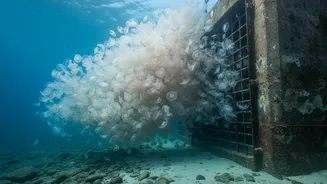
Coastal nuclear power plants rely on a constant, massive flow of cool water from the sea. This water is pulled through large intake pipes to cool the steam that turns the electricity-generating turbines. To prevent fish, seaweed, and other debris from entering the system, these pipes are protected by a series of filters and screens. The problem arises when a “bloom”—a sudden, dense swarm of jellyfish—is pulled toward the intakes. Due to their soft bodies, they can pass through the initial coarse filters, but they then get plastered against finer mesh screens, blocking them completely. This creates a thick, gelatinous wall that restricts or halts the flow of cooling water. Automatic safety systems detect the drop in water pressure and, as a precaution, shut down the reactors to prevent overheating.
A Global Phenomenon
The list of jellyfish-induced shutdowns is long and geographically diverse. In 2013, Sweden’s largest reactor at Oskarshamn was shut down by a swarm of moon jellyfish. This wasn't a first for the plant, which had a similar issue in 2005. Scotland's Torness plant was forced offline in 2011 and again in 2021 for the same reason. In the United States, California's Diablo Canyon plant has been shut down by both jellyfish and similar creatures called salps. Power plants in Israel and Japan have also reported issues, and a massive jellyfish swarm was even responsible for a major blackout in the Philippines in 1999. These events are costly, leading to lost revenue and significant cleanup efforts.
The Rise of the Blooms
So why is this happening more frequently? Marine biologists suggest several factors are contributing to a global increase in jellyfish populations. Rising sea temperatures, linked to climate change, extend the breeding season for many jellyfish species. Overfishing has removed many of the jellyfish's natural predators and competitors, allowing their numbers to explode. Additionally, nutrient runoff from agriculture can create coastal water conditions where jellyfish thrive better than other marine life. Some research even suggests that the slightly warmer water discharged by the power plants themselves might create a favorable environment for jellyfish, though more study is needed. The result is more frequent and larger swarms drifting with the currents, right into the path of power plant intakes.
Defending the Intakes
Plant operators are not sitting idly by. They are developing more sophisticated methods to handle the gelatinous threat. Some plants now use sonar and even robotic underwater vehicles to detect approaching swarms, creating an early-warning system. Others have deployed fishing vessels to patrol the waters and physically break up or divert blooms before they reach the plant. Engineering solutions include stronger, more robust filtration systems designed to withstand the weight of a jellyfish clog and automated cleaning mechanisms to clear them more quickly. At Diablo Canyon, teams of scuba divers have had to physically scrape the creatures off the intake screens after an event. These measures are designed to reduce downtime and ensure the plants can continue to operate safely.