





A Match Made Across Worlds
In a testament to the enduring value of space exploration, scientists have uncovered a fascinating link between the lunar south pole and a frozen expanse on Earth. Researchers at India's Physical Research Laboratory (PRL) in Ahmedabad analyzed data from
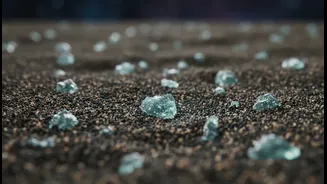
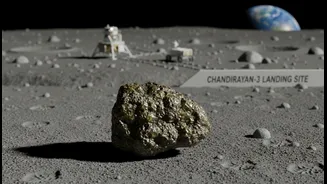
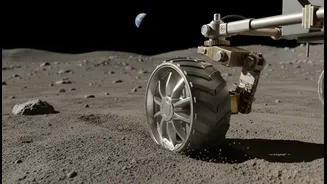
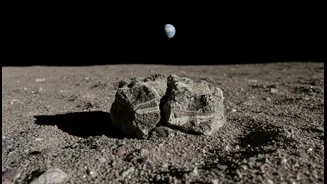
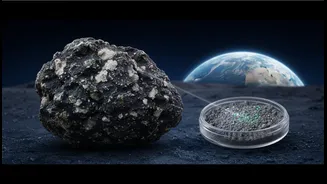
the Pragyan rover’s Alpha Particle X-ray Spectrometer (APXS). They found that the chemical composition of the soil at 'Shiv Shakti Statio,' Chandrayaan-3's landing site, bears a striking resemblance to a lunar meteorite found on our planet. By comparing the rover's on-site analysis with the properties of 66 known lunar meteorites, the team identified one specific rock as an incredibly close geochemical match. This discovery bridges the gap between remote analysis on the Moon and hands-on laboratory studies on Earth, providing a powerful new tool for understanding our celestial neighbour.
The Antarctic Connection: ALHA 81005
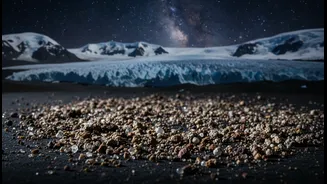
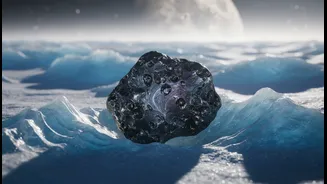
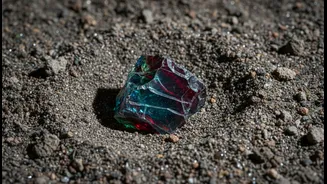
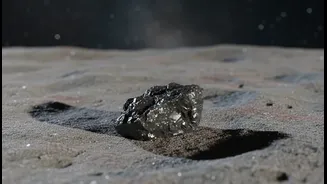
The meteorite in question is no ordinary space rock. Named ALHA 81005, it was discovered in the Allan Hills region of Antarctica during an expedition in 1981-82. This particular specimen holds a special place in scientific history, as it was the very first rock found on Earth to be conclusively identified as having originated from the Moon. Before ALHA 81005, scientists primarily relied on samples returned by the Apollo missions. The discovery of lunar meteorites—rocks blasted off the Moon’s surface by asteroid impacts that later fall to Earth—opened up a new, random sampling of the lunar surface. The fact that Chandrayaan-3’s data now aligns so closely with this historic meteorite creates a remarkable link between a decades-old discovery and cutting-edge space science.
What the Chemistry Reveals
The connection lies in the specific elemental recipe of the soil and the rock. The Pragyan rover’s analysis showed that the Shiv Shakti site has lower levels of aluminium oxide and higher levels of iron and magnesium oxides compared to typical lunar highland regions. When PRL scientists sifted through the data on known lunar meteorites, ALHA 81005 stood out. Both the landing site and the meteorite have nearly identical amounts of aluminium oxide (around 26%) and a very similar combined total of iron and magnesium oxides (around 14%). This specific composition places both samples in a rare category between two major types of lunar crustal rocks, known as ferroan anorthosites (FAN) and Mg-suite rocks. This isn't just a minor similarity; it’s a shared chemical fingerprint that points to a common type of geological origin.
An Important Scientific Distinction
While the headline-grabbing match is exciting, ISRO and the PRL researchers have been careful to add an important clarification: this does not mean the ALHA 81005 meteorite was blasted off from the exact spot where Chandrayaan-3 landed. The journey of a lunar meteorite is chaotic, making it nearly impossible to trace its precise point of origin. Instead, the finding indicates that both the Shiv Shakti site and the rock that became ALHA 81005 represent a similar and relatively uncommon type of magnesium-rich lunar crust. This is arguably more significant, as it suggests that this type of crustal material could be more widespread in the Moon's south polar region than previously known, offering a reference point for studying other lunar samples.
Piecing Together the Moon’s Past
This discovery has profound implications for understanding the Moon’s history. The unusual, magnesium-rich composition at the landing site supports a key theory about the Moon's formation: the Lunar Magma Ocean (LMO) hypothesis. This theory suggests the early Moon was covered in a sea of molten rock, and as it cooled, different minerals crystallised and settled to form the crust and mantle. The mixed nature of the soil at Shiv Shakti Statio, which appears to contain material from deeper layers of the crust, suggests that ancient, colossal impacts have churned the lunar surface over billions of years. Scientists speculate that the massive impact that formed the South Pole-Aitken basin, located about 350 km away, could have excavated this deeper material and scattered it across the region where Chandrayaan-3 now explores.