



A Cosmic Headcount Problem
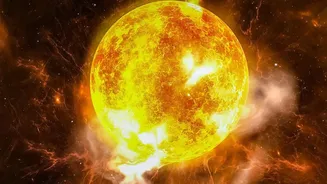
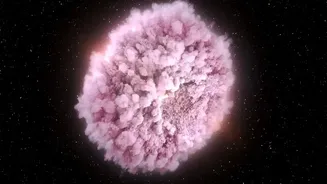
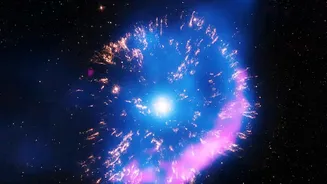
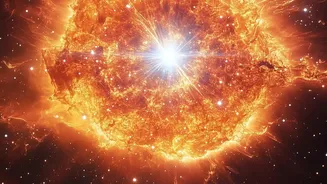
Across the vastness of the observable universe, a massive star is expected to die in a cataclysmic explosion, known as a core-collapse supernova, about once every second. These events are responsible for creating the heavy elements essential for life.
Yet, when astronomers point their telescopes to the skies, the numbers don't add up. They observe significantly fewer of these brilliant stellar deaths than theoretical models of star formation and evolution predict. This discrepancy is known as the "supernova rate problem," a persistent puzzle that has left scientists wondering where all the missing explosions have gone.
The Ghost Particle Solution
The answer may lie not in what we can see, but in what we can't. Enter the neutrino, a fundamental particle so small and so neutral that it barely interacts with matter at all. Often called "ghost particles," trillions of them are passing through your body right now, completely unnoticed. Supernova explosions are one of the most powerful sources of neutrinos in the universe, releasing about 99% of their colossal energy in the form of these particles. While the flash of light from a supernova might be obscured by dust or fail to happen at all, the burst of neutrinos always escapes. This makes them a potentially perfect tool for conducting an accurate cosmic census.
Listening for a Cosmic Hum
While we have detected neutrinos from a single, relatively close supernova (SN 1987A), the new research focuses on a different signal: the Diffuse Supernova Neutrino Background (DSNB). This is a faint, constant, and universal hum made up of all the neutrinos from every supernova that has ever occurred throughout cosmic history. It's a relic signal that, if detected, would provide a direct measure of the total number of stellar collapses, not just the ones that produced a bright, visible explosion. Until now, this background has been purely theoretical, but advanced detectors are getting closer to making the first definitive detection.
The Importance of 'Failed' Supernovae
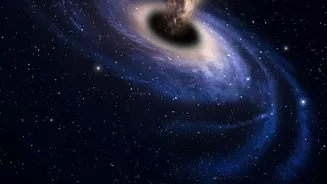
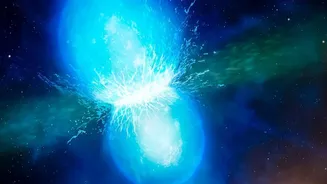
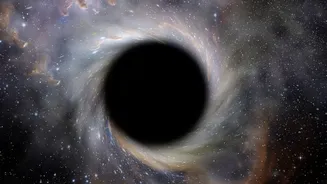
The latest work, published in the journal Physical Review D, focuses on a fascinating aspect of this puzzle: the role of neutrino behavior in the star's final moments. New simulations show that for a significant range of massive stars, the way neutrinos change between their different types, or "flavors," can determine the star's ultimate fate. In many cases, this neutrino activity can cause a star to collapse directly into a black hole without producing a traditional, optically bright supernova. These are the so-called "failed supernovae." They would be invisible to conventional telescopes, but they would still release a massive burst of neutrinos, contributing to the DSNB.
How New Research Changes the Game
The study, led by researchers at the University of Copenhagen, ran 195 simulations and found a clear pattern: including the effects of neutrino flavor conversion caused a whole range of stars, particularly those 16 to 30 times the mass of our sun, to fail to explode when they otherwise would have. This provides a compelling physical mechanism for the missing supernova problem. The stars aren't missing; they're just dying quietly, collapsing into black holes. By accounting for these optically dark events, the total rate of core collapse could align perfectly with theoretical predictions. The work suggests that future neutrino observatories, like Japan's Hyper-Kamiokande, could finally confirm this by measuring the DSNB and revealing the true rate of stellar death.