





A Symphony from the Abyss
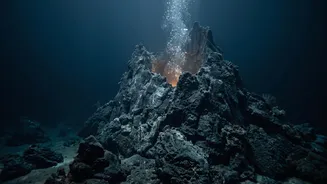
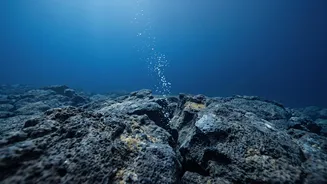
Seventy percent of Earth’s volcanic activity happens underwater, yet much of it goes unseen and undetected. These submarine volcanoes, however, are far from quiet. They produce a complex soundscape that scientists are just beginning to understand. The sounds range
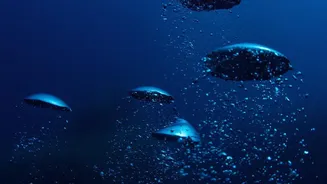
from the low-frequency humming of magma moving deep within the earth's crust to sharp, impulsive pops caused by the explosive interaction of hot lava and cold seawater. Researchers have identified distinct acoustic signatures for different volcanic events. For instance, short, low-frequency noises can indicate bursts of magma, while longer, broadband sounds can signify the chaotic release of gas bubbles. Even the process of rock sagging and fracturing as a magma chamber empties can produce a unique resonance that travels thousands of miles. This rich variety of sounds provides clues not just that a volcano is active, but how it is behaving.
The Ocean’s Listening Network
To capture these faint sounds from the deep, scientists rely on hydrophones—essentially underwater microphones. These sensitive instruments can be deployed in several ways. Some are moored to the seafloor in arrays near known volcanic hotspots, like the Axial Seamount off the U.S. West Coast, which is the world's most advanced underwater volcano observatory. Others are part of large-scale monitoring networks, such as those once used for military surveillance or those established to monitor for nuclear tests, which can detect volcanic activity from thousands of kilometers away. The ocean itself helps this process. Sound travels incredibly efficiently through water, especially within a specific layer known as the SOFAR (Sound Fixing and Ranging) channel, which acts as a waveguide, allowing acoustic signals to propagate over vast distances with little energy loss. Seismic waves from eruptions also convert into acoustic waves, called T-waves, at the seafloor, which hydrophones are perfectly designed to detect.
Learning the Volcanic Language
Recording volcanic sounds is one thing; interpreting them is another. This is the crucial work that scientists are currently focused on: building a dictionary that translates specific sounds into specific volcanic processes. By combining acoustic data with video from remotely operated vehicles (ROVs) and direct measurements of the seafloor, researchers can link a particular sound to a visual event, like a lava flow or a gas explosion. For example, studies at Axial Seamount have correlated tens of thousands of impulsive signals with the emplacement of new lava flows on the ocean floor. Recent analysis of the catastrophic 2022 Hunga Tonga-Hunga Ha'apai eruption revealed that a massive underwater sound signal was not from the initial explosion, but from the subsequent collapse of the volcano's caldera—the event that generated the most destructive tsunami. This discovery is vital, as it suggests that different sounds can herald different types of hazards.
The Ultimate Goal: Forecasting Eruptions
The promise of this research is the development of more robust early warning systems. While land-based volcanoes are often monitored with GPS and tiltmeters to detect ground swelling, this is much harder to do underwater. Acoustics offers a way to monitor remote submarine volcanoes in real-time. Pre-eruptive activity, such as the movement of magma, often generates a flurry of small earthquakes and distinct acoustic signals hours before an eruption. At Kick 'em Jenny, a submarine volcano in the Lesser Antilles, a spike in volcanic earthquakes allowed scientists to raise the alert level just before a small eruption in 2001. More significantly, the sound from a volcano-collapsing event travels through water much faster than the resulting tsunami. The acoustic signal from the Hunga caldera collapse, detectable thousands of kilometers away, offers the potential to provide a crucial window of warning for deadly tsunamis generated by similar events in the future.
The Challenges of Eavesdropping
Despite its great promise, hydroacoustic monitoring is not a simple solution. The ocean is a noisy place, filled with the sounds of shipping, marine life, and non-volcanic seismic activity. Distinguishing the faint rumble of a distant volcano from this background cacophony is a significant data processing challenge. Furthermore, deploying and maintaining hydrophone networks, especially in the deep ocean, is complex and expensive. While cabled observatories like the one at Axial Seamount provide invaluable real-time data, most of the world's hundreds of thousands of submarine volcanoes are not monitored at all. Scientists must first establish reliable benchmarks to know which sounds signal a genuine threat versus which are just background noise, a process that requires observing many more eruptions to build a comprehensive library of volcanic behavior.