



A Picture Worth a Thousand Mysteries
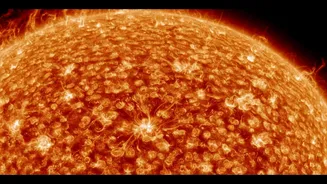
Scientists have released the highest-resolution image ever captured of our Sun's surface in visible light, and it’s spectacular. Taken by the powerful Daniel K. Inouye Solar Telescope in Hawaii, the image reveals our star not as a uniform ball of light, but
as a turbulent, intricate tapestry of roiling plasma. The image shows flower-like structures, which are the tops of solar granules, and swirling vortices at their edges. These details, some as small as a city, are providing unprecedented evidence for a process called the Kelvin-Helmholtz instability (KHI), which occurs when two streams of plasma flow past each other at different speeds. Long theorized to happen on the Sun, these instabilities have now been directly observed, offering a visual key to understanding the Sun's chaotic nature.
The Coronal Heating Problem
For nearly a century, solar physicists have been puzzled by something called the “coronal heating problem.” In simple terms, the Sun's outer atmosphere, the corona, is hundreds of times hotter than its visible surface. While the surface simmers at around 6,000 degrees Kelvin, the corona sizzles at over a million degrees. This defies simple logic; it’s like a fire being cooler than the air far above it. It's widely accepted that the Sun's magnetic field is responsible for transporting the necessary energy upwards, but the exact mechanism has been the subject of intense debate. Scientists have proposed two main families of explanations: the dissipation of magnetic waves, known as Alfvén waves, and a storm of tiny, constant explosions called nanoflares.
What the New Image Reveals
This is where the new, ultra-sharp images come in. By visualizing the Kelvin-Helmholtz instabilities, scientists can see direct evidence of how energy is transferred and dissipated at the Sun's surface. These swirls and eddies created by the instability are a form of turbulence. This turbulence can cause magnetic field lines to twist, break, and reconnect, a process that releases tremendous amounts of energy—potentially in the form of nanoflares. Alternatively, this turbulence could also be what causes larger magnetic waves to break and deposit their energy, heating the plasma. Future research using these high-resolution images may help determine how these instabilities contribute to moving energy into the corona, potentially heating it.
Future Missions and a Clearer Picture
The Inouye Solar Telescope is a ground-based observatory, but it's part of a fleet of new tools aimed at solving this solar puzzle. NASA's upcoming Multi-slit Solar Explorer (MUSE) mission is designed to provide an even more detailed look. Scheduled for launch around 2027, MUSE will observe the Sun in extreme ultraviolet light, capturing the highest resolution images ever of the corona itself. By using a new technique called multi-slit spectroscopy, it will be able to measure the temperature, velocity, and turbulent motions of the plasma 100 times faster than previous missions. This will allow scientists to directly compare the theories of coronal heating with detailed observations, bridging the gap between models and reality.
Why It Matters Here on Earth
Understanding how the Sun works isn't just an academic exercise. The same forces that heat the corona also power solar flares and coronal mass ejections (CMEs)—huge eruptions of plasma and magnetic fields from the Sun. When directed at Earth, these events create space weather. Severe space weather can disrupt GPS signals, damage communications satellites, endanger astronauts, and even bring down electrical power grids on the ground. By building a better model of the fundamental physics driving our star's activity, scientists can improve their ability to forecast space weather, giving us the chance to protect our increasingly technology-dependent society from its impacts.