

More Than Just Cracks in the Ice
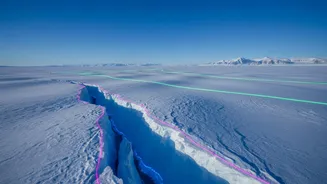
A crevasse is a deep fracture in a glacier, formed when the ice is put under immense stress by its own movement. Think of it like a piece of dough: pulled slowly, it stretches; yanked quickly, it rips. The same thing happens with ice on a massive scale.
When a glacier speeds up, flows over an uneven bedrock, or spreads out, the stress can exceed the ice's ability to deform, causing it to fracture. These aren't just surface-level features; crevasses can be hundreds of feet deep, often hidden by thin snow bridges, making them a serious hazard for scientists on the ground. They are the visible language of stress within the ice, mapping out where the greatest forces are at play.
The Power of Ice Streams
At the heart of this process are ice streams—vast, fast-flowing corridors of ice within the larger, slower Antarctic Ice Sheet. These continent-sized rivers of ice can move at speeds of up to 800 metres per year, discharging the vast majority of Antarctica's ice into the ocean. This movement creates different types of stress. Where the ice stretches and accelerates, transverse crevasses form across the direction of flow. Where it grinds against slower-moving ice or rock walls at its margins, shear crevasses form in a distinctive herringbone pattern. And where the ice stream spreads out, longitudinal crevasses open up parallel to the flow. It is the interplay of these forces that transforms simple, isolated fractures into continent-spanning networks.
A Natural Laboratory for Fracture
Recent studies, particularly on major systems like the Thwaites and Pine Island glaciers, have provided an unprecedented look at how these networks evolve. Using satellite radar and deep learning algorithms, scientists can now map crevasse distribution across the continent with incredible detail, tracking changes on a monthly basis. These observations show that crevasse patterns aren't random. They reveal the boundaries of different ice flows, highlight areas of intense strain, and can even expose features of the hidden bedrock far below. Some studies have even used remotely operated underwater vehicles to explore crevasses from below, finding that they channel ocean water in previously unknown ways, altering melt patterns.
From Fracture to Full-Blown Network
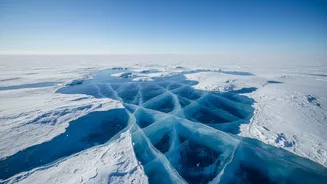
The creation of a complex network is a dynamic process. An initial crack can be widened and deepened by the stress of flowing ice. More recently, research has focused on the role of water. Surface meltwater can pour into a crevasse, a process known as hydrofracturing, which can wedge the crack open and further weaken the surrounding ice. Similarly, warm ocean water can exploit basal crevasses on the underside of floating ice shelves, carving out complex shapes and speeding up melt. Research on the Thwaites Glacier has revealed that these basal crevasses can seed the growth of new fractures, creating a feedback loop where melting and cracking reinforce each other. Over years and decades, these interconnected processes link individual fractures into vast, intricate webs that can compromise the structural integrity of an entire ice shelf.
Why These Cracks Matter Globally
Understanding crevasse networks is not just an academic exercise in glaciology; it is critical for predicting future sea-level rise. Ice shelves—the floating tongues of ice that extend from the coast—act like a cork in a bottle, holding back the flow of glaciers from the land into the ocean. Extensive crevasse networks weaken these ice shelves, making them more vulnerable to collapse. Recent research shows that on ice shelves with high rates of basal melt, it could take only decades or a couple of centuries for crevasses to penetrate the full thickness of the ice, leading to disintegration. As these buttressing shelves weaken or break apart, inland glaciers accelerate, dumping more ice into the sea. Mapping these fractures helps scientists identify which ice shelves are most at risk, improving models that project how much and how quickly our coastlines might change in a warming world.