


A Tale of Two Orbits
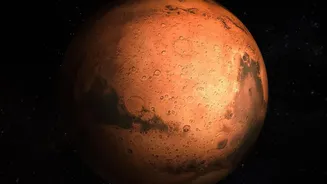
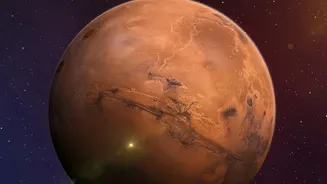
Like Earth, Mars has seasons because its axis is tilted. Earth’s tilt is about 23.5 degrees, while Mars’s is a similar 25 degrees. This tilt means that for parts of the year, one hemisphere is angled toward the Sun while the other is angled away. However,
the similarities largely end there. The real source of Mars’s extreme climate swings is its orbit. While Earth’s path around the Sun is nearly a perfect circle, Mars follows a much more elliptical, or egg-shaped, path. This high eccentricity means the distance between Mars and the Sun varies significantly throughout its year. At its closest point (perihelion), Mars receives about 40-45% more solar energy than at its farthest point (aphelion). For Earth, this variation is only about 7%. This huge difference in solar radiation is the engine behind the planet's wildly different seasonal intensities.
An Intense Southern Summer
This orbital quirk has a profound effect because of a cosmic coincidence: Mars reaches its closest point to the Sun during the southern hemisphere's summer. This timing supercharges the season, making southern summers on Mars much hotter and shorter than summers in the northern hemisphere. Conversely, the southern hemisphere experiences a long, frigid winter when the planet is farthest from the Sun. The northern hemisphere experiences the opposite: relatively mild, long summers and shorter, less severe winters. This creates a planet with two distinct climate personalities. Summer temperatures in the south can be up to 30°C warmer than their northern counterparts, a staggering difference that sets the stage for dramatic atmospheric events. This lopsided heating is the trigger for some of the most spectacular weather in the solar system.
The Planet of Global Dust Storms
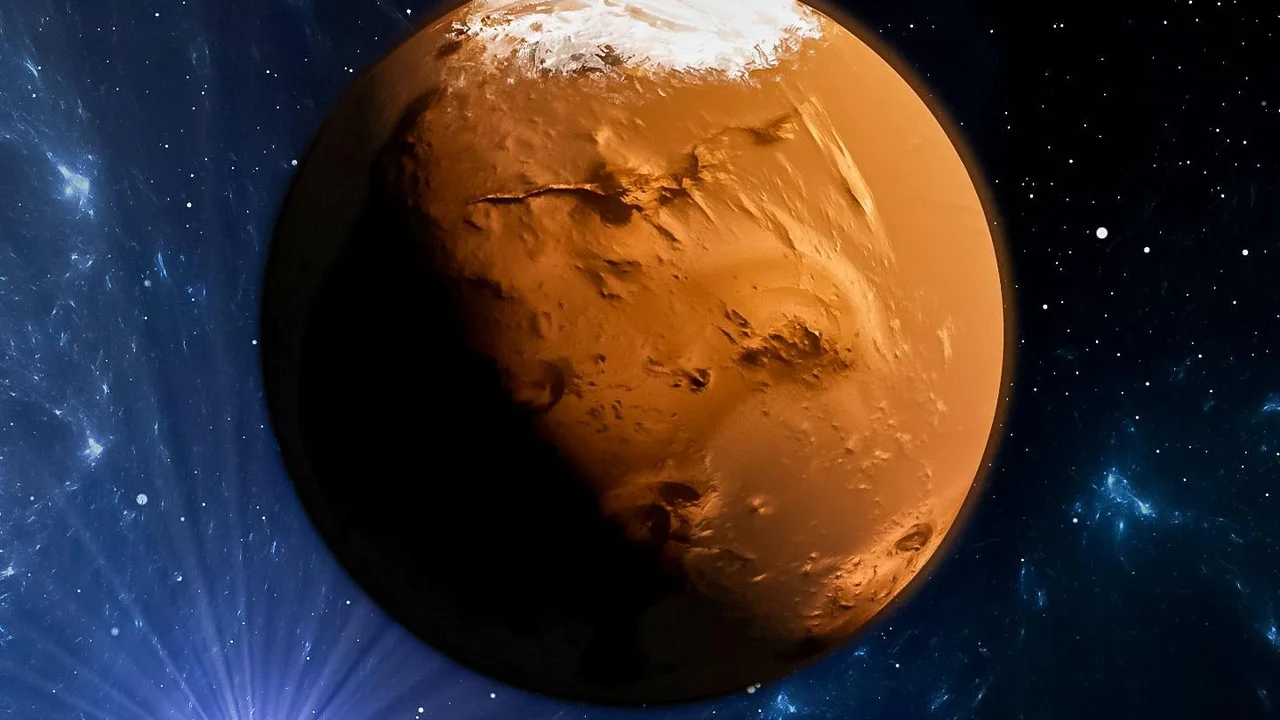
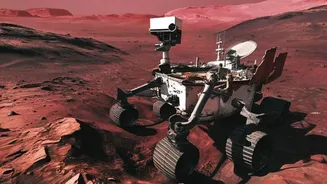
The most dramatic consequence of this intense southern summer heating is the formation of colossal dust storms. As the sun beats down on the southern polar ice cap, it causes large amounts of carbon dioxide ice to sublimate, or turn directly into gas. This process, combined with the intense surface heating, generates powerful winds. These winds can lift the fine Martian dust high into the thin atmosphere. As the airborne dust absorbs sunlight, it heats the air around it, creating a positive feedback loop that generates even stronger winds, which lift more dust. What starts as a local or regional storm can rapidly grow, sometimes in a matter of weeks, to engulf the entire planet. These global dust storms, which can occur every three to four Martian years (about 6 to 8 Earth years), plunge the planet into a reddish haze for months, blocking out the sun and posing a significant challenge for solar-powered rovers like Opportunity, whose mission was ultimately ended by a massive storm in 2018.
Implications for Water and Exploration
This seasonal heating cycle does more than just kick up dust. It plays a crucial role in the movement of water on Mars. The intense summer sun causes water ice in the polar caps to sublimate, releasing water vapor into the atmosphere. This vapor can then circulate and re-deposit as frost or ice in cooler regions. Understanding this modern water cycle is critical for scientists searching for signs of past or present life, as well as for identifying resources for future human missions. The volatility of the Martian climate, especially the threat of global dust storms, is a primary concern for mission planners. Forecasting this extreme weather is essential for the safety and success of robotic and, eventually, human explorers on the Red Planet. Studying these powerful seasonal shifts gives us a window into a climate system far more dynamic and extreme than our own.