





Ithaca, Greece: The Ultimate Homecoming
The entire ten-year journey of Odysseus is driven by one singular goal: to return to his rugged island kingdom of Ithaca. It’s the story's anchor, representing not just a place but the idea of home, family, and peace. Today, the real Ionian island of Ithaca is a tranquil
paradise, far from the mass tourism of other Greek isles. It’s an island of quiet coves, sleepy fishing villages like Kioni and Frikes, and dramatic, rocky coastlines. Visitors can hike the 'Odysseus Trail' or explore sites linked to the hero, such as the Cave of the Nymphs, where he supposedly hid his treasures upon his return. Visiting Ithaca isn’t just about seeing a beautiful island; it’s about feeling the emotional core of the epic. Standing on its shores, you can appreciate the profound longing that fuelled a decade of wandering and understand why, after all the monsters and magic, this humble kingdom was the only prize worth having.
Strait of Messina, Italy: Between Scylla and Charybdis
Every great story needs an impossible choice, and for Odysseus, it came in the form of two sea monsters. In a narrow strait, he had to navigate between Scylla, a six-headed beast who would snatch sailors from his deck, and Charybdis, a monstrous whirlpool that would swallow his entire ship. This legendary passage is widely believed to be the Strait of Messina, the turbulent stretch of water separating Sicily from mainland Italy. The powerful currents and natural whirlpools that still exist here show how ancient sailors could have imagined such terrifying monsters dwelling in the depths. A visit today allows you to stand on the Calabrian coast near the rock of Scylla or the Sicilian shore at Capo Peloro, looking out at the churning waters. You can imagine the sheer terror of that choice—lose six men or risk losing everyone. It’s a place that embodies raw, natural power and the high-stakes tension a director like Nolan would relish capturing on screen.
Sicily, Italy: The Land of the Cyclops
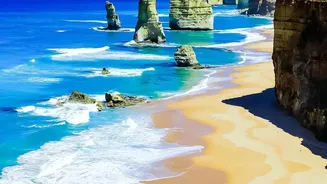
One of the most famous episodes in The Odyssey is the harrowing encounter with Polyphemus, the one-eyed Cyclops. After being trapped in his cave, Odysseus blinds the giant to escape. As they sail away, the enraged Cyclops hurls massive boulders at their ship. This mythical land is strongly associated with the eastern coast of Sicily, particularly the area around the still-active volcano, Mount Etna. Along the 'Riviera dei Ciclopi' (Riviera of the Cyclops), near the town of Aci Trezza, you can see the 'Faraglioni'—jagged stacks of volcanic rock rising from the sea, said to be the very stones Polyphemus threw. The landscape here feels primal and immense, with coastal caves and the imposing presence of Etna dominating the horizon. It’s easy to see how this dramatic scenery inspired tales of giants. Exploring this coastline offers a visceral connection to the brutal, survivalist horror of the encounter.
Gozo, Malta: Calypso’s Island of Ogygia
Not all of Odysseus's trials were monstrous battles; some were tests of will. For seven years, he was held captive on the island of Ogygia by the beautiful nymph Calypso, who offered him immortality if he would stay and be her husband. Though a paradise, it was a prison. Odysseus spent his days weeping on the shore, longing for home. Tradition strongly identifies Ogygia with Gozo, Malta's serene sister island. High on the cliffs above the stunning red sands of Ramla Bay is a spot known as Calypso's Cave, believed to be her home. While the cave itself is unstable, the viewpoint offers a breathtaking panorama of the sea. Gozo’s dramatic cliffs and tranquil, isolated feel perfectly capture the beautiful but melancholic captivity Odysseus endured. It’s a place to contemplate the theme of time—a favorite of Nolan’s—and the choice between a perfect, eternal present and a difficult journey toward a meaningful future.
Monte Circeo, Italy: Circe's Island of Aeaea
Before facing the Underworld, Odysseus and his crew landed on Aeaea, the island of the sorceress Circe. Here, she famously turned his men into swine with her magical potions before Odysseus, with divine help, bested her and won her allegiance. While several locations have been proposed, classical writers often identified Aeaea with Monte Circeo, a dramatic promontory on the coast of Italy, between Rome and Naples. In ancient times, surrounding marshes would have made this mountain appear as an island. Today, the area is a national park, a dense forest of oak and beech that feels otherworldly. Visiting Monte Circeo allows you to imagine walking into Circe's domain, a place of dangerous beauty and magical transformation. It's a landscape where the natural world feels enchanted, a perfect setting for the mind-bending and transformative chapter of Odysseus's journey, where a powerful adversary becomes an essential guide.