

A Crowd of Black Holes
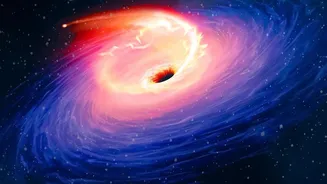
In a galaxy known to astronomers as J0148-4214, an international team of scientists has identified what appears to be a trio of supermassive black holes. This is a landmark discovery, marking the first time three actively feeding black holes have been
spotted together in a single galaxy so early in the universe's history. We are observing this galaxy as it existed just 1.2 billion years after the Big Bang. Two of the black holes are huddled close together near the galactic centre, while a third is located further out. Their masses are immense, with the largest estimated to be 80 million times that of our Sun, and the other two weighing in at about two million and 600,000 solar masses, respectively. Finding such a crowded system provides a rare snapshot into the chaotic and formative years of the cosmos.
How to See the Invisible
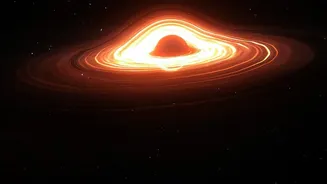
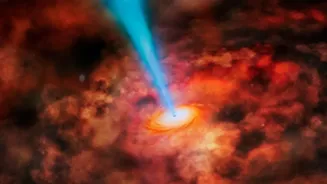
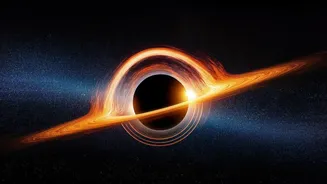
Supermassive black holes, by their very nature, are impossible to see directly as their gravitational pull is so strong that not even light can escape. So how did scientists find them? They used a clever technique with the James Webb Space Telescope's powerful Near-Infrared Spectrograph, or NIRSpec. Instead of looking for the black holes themselves, they looked for their fingerprints. As gas and dust are pulled towards a black hole, they form a swirling, superheated disc called an accretion disk. The NIRSpec instrument can analyse the light coming from this gas, specifically the light emitted by hydrogen. By studying the spectrum of this light, scientists detected the tell-tale signs of gas moving at incredibly high speeds—a clear indication that it was being whipped around by the immense gravity of not one, but three, separate black holes.
When Galaxies Collide
How does a single galaxy end up with three supermassive black holes? The leading theory is through galactic mergers. In the early universe, galaxies were closer together and frequently collided and merged. Most large galaxies, including our own Milky Way, are believed to host a supermassive black hole at their centre. When galaxies merge, their central black holes are drawn towards each other, eventually settling into a close orbit before they too merge. The discovery of a triple system like J0148-4214 is powerful evidence for this process. It suggests a scenario where at least two, and possibly three, galaxies have smashed together, bringing their resident black holes along for the ride. This cosmic dance of destruction and creation is a fundamental way that galaxies and the giants within them grow over billions of years.
Rewriting the Cosmic Story
This discovery does more than just set a new record. It helps answer one of the biggest questions in cosmology: how did supermassive black holes get so big, so fast? Finding them already enormous in the early universe has long puzzled astronomers. This triple system strongly suggests that frequent mergers were a key factor, providing a rapid growth path. Furthermore, this system is a preview of events we hope to detect in the future. The two central black holes are on a collision course and are expected to merge. Such an event would unleash a torrent of gravitational waves—ripples in the fabric of spacetime. While current technology cannot detect the waves from this specific event, systems like J0148-4214 are exactly the kind of targets that future space-based observatories, such as the Laser Interferometer Space Antenna (LISA), will be looking for.