





Running and jumping rope are two of the most accessible cardio workouts around. Both get your heart pumping, but they challenge your body in fundamentally different ways. The real question for those looking to master a skill isn't just about calories.
The Rhythm of the Run
Running is a masterclass in sustained rhythm and pacing. The timing involved is about creating and holding a consistent cadence over a long duration. Your body finds a groove, with arms and legs working in opposition to maintain forward momentum and balance. This timing is largely cyclical and predictable; once you settle into a pace, the goal is to maintain it. It requires coordinating your entire body to work efficiently, managing your stride length and foot strikes to conserve energy. This form of timing is about endurance and consistency, teaching your body to maintain a steady, repetitive motor pattern for miles on end. The focus is less on split-second reactions and more on the long-term metronome of your own movement.
The Snap of the Rope
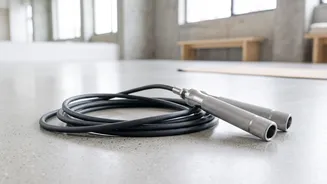
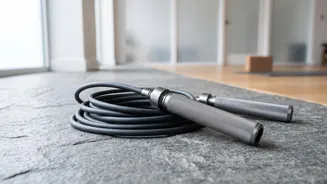
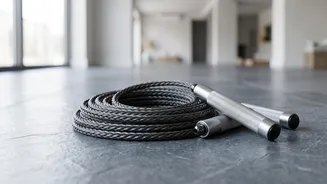
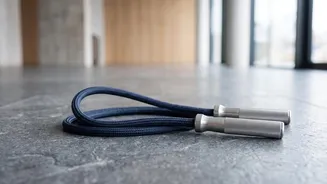
Jumping rope operates on a different timescale. It demands acute, highly precise, and reactive timing. With every rotation, your body must execute a perfect, split-second jump, clearing the rope by mere centimetres. Your hands, wrists, and feet must work in perfect synchrony. A slight miscalculation in the speed of the rope or the height of your jump results in an immediate mistake—the rope catches your feet and the rhythm is broken. This is a constant feedback loop that hones neuromuscular control. Unlike the sustained rhythm of a run, jumping rope is about a series of explosive, plyometric movements that require constant adjustment and intense concentration. The demand is for precision in short, repetitive bursts.
A Biomechanical Breakdown
From a biomechanics perspective, both activities train your body's internal clock, but for different purposes. Running improves your ability to gauge pace and maintain effort. Jumping rope, however, is a powerful tool for improving coordination and proprioception—your body's sense of its position in space. Research has shown that jump rope training improves reactive strength and the body's ability to coordinate between the upper and lower limbs. It requires your central nervous system to make rapid-fire adaptive responses. If running is like holding a steady beat, jumping rope is like being the drummer, responsible for every single, perfectly timed strike. This is why many athletes, from boxers to runners, use jumping rope to enhance footwork, agility, and overall coordination.
So, Which Is More Demanding?
When it comes to the sheer precision of timing, jumping rope has the edge. The margin for error is significantly smaller and the feedback for failure is instant. While running requires excellent rhythm over distance, the movement itself is more natural for most people. Jumping rope is a learned skill that explicitly challenges the connection between your eyes, hands, and feet in a way running does not. Studies and experts often highlight that jumping rope requires more coordination. A runner can have an 'off' stride and recover seamlessly, but a jumper's mistimed movement immediately stops the exercise. This constant demand for perfect, repetitive timing makes it a superior exercise for building acute neuromuscular precision.
Beyond Timing: Choosing Your Workout
Ultimately, the 'better' workout depends entirely on your goals. If you aim to build long-distance endurance and enjoy a change of scenery, running is an unbeatable choice. It is also generally easier for beginners to start, as the basic movement is more innate. However, if you are short on time, need a workout you can do in a small space, and want to specifically train coordination, agility, and explosive power, jumping rope is incredibly effective. In fact, some studies have shown that 10 minutes of jumping rope can offer similar cardiovascular benefits to 30 minutes of jogging. Many find that the best approach is to combine both, using running for endurance and jump rope for high-intensity conditioning and skill work.