







A Tale of Two Lunar Samples
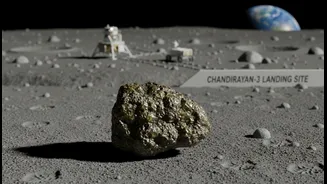
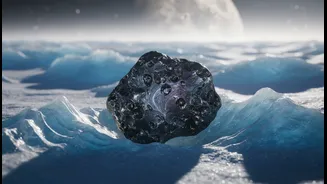
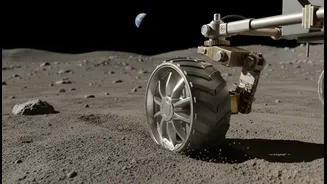
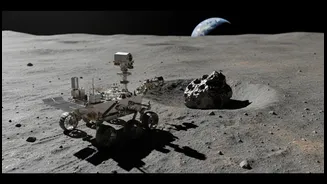
Imagine two seemingly disconnected items: one is the soil at the 'Shiv Shakti Statio' landing site on the Moon's south pole, analysed in August 2023 by the Pragyan rover. The other is a small, greenish-tan rock, ALHA 81005, discovered in the icy expanse
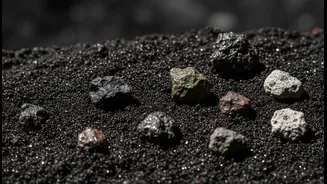
of Antarctica's Allan Hills back in 1982. For decades, ALHA 81005 held a special status as the very first meteorite found on Earth that was scientifically confirmed to have been blasted off the Moon's surface by an ancient impact. For years, it was a priceless, tangible piece of the Moon available for study in labs. Now, scientists from the Physical Research Laboratory (PRL) in Ahmedabad have found that the chemical fingerprint of the soil studied by Chandrayaan-3 is a near-perfect match for this historic meteorite.
The Cosmic Fingerprint Match
The connection was made using data from the Alpha Particle X-ray Spectrometer (APXS) aboard the Pragyan rover. This instrument bombards the lunar surface with particles to analyse the characteristic X-rays that each element emits, effectively reading its chemical composition. When PRL scientists compared the APXS data from the landing site against the known compositions of 66 lunar meteorites found on Earth, one stood out: ALHA 81005. The match is strikingly close. Data shows the soil at Shiv Shakti Statio contains about 26.1% aluminium oxide, while the meteorite has 25.8%. Similarly, the combined iron and magnesium oxide content is 14.4% at the landing site and 13.7% in the meteorite—nearly identical, and significantly different from the typical lunar highlands. This doesn't mean the rock came from that exact spot, but it confirms both represent the same rare type of lunar crust.
An Unusual and Important Rock Type
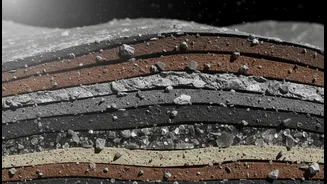
Both the Chandrayaan-3 site and ALHA 81005 occupy a rare compositional space, falling between two major categories of lunar rock: the aluminium-rich 'ferroan anorthosites' (FAN) and the denser, magnesium-rich 'Mg-suite' rocks. The landing site soil appears to be a mixture, containing not just surface material but also fragments of magnesium-rich rock that were likely excavated from deep within the Moon's crust by a major impact event, possibly the one that formed the giant South Pole-Aitken basin. This makes the finding incredibly valuable. It suggests the Chandrayaan-3 landing site is a geologically complex area that preserves a record of materials from different layers of the Moon's crust, churned up and mixed over billions of years.
Why This Discovery Is a Milestone
This discovery is significant on multiple fronts. Firstly, it serves as a powerful validation of ISRO's technology. The accuracy of the APXS instrument's on-the-spot analysis is confirmed by a physical sample that has been studied in laboratories for over 40 years. Secondly, it strengthens our entire understanding of lunar geology. For decades, scientists have studied lunar meteorites and made assumptions about the Moon's composition. This finding provides a direct, ground-truthed link between a specific location on the Moon and a sample here on Earth, helping to calibrate and confirm decades of research. It also lends more weight to the 'Lunar Magma Ocean' hypothesis—the idea that the Moon was once covered by a sea of molten rock, and as it cooled, different minerals formed the crust we see today.