




A Grand Tour of Solar System Fossils
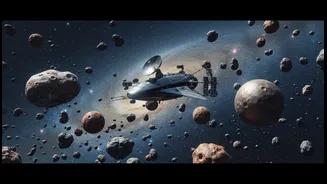
NASA’s Lucy spacecraft is on an audacious 12-year journey to visit a record-breaking number of asteroids. Launched in 2021, its primary targets are the Jupiter Trojans: two swarms of ancient space rocks that lead and follow the giant planet in its orbit.
These Trojans are considered 'fossils of planet formation,' pristine remnants from the chaotic birth of our solar system more than four billion years ago. Studying them up close is like opening a time capsule, offering invaluable clues about where the planets came from. The mission is named after the fossilized hominin skeleton 'Lucy,' because it promises to revolutionize our understanding of our cosmic origins. Before Lucy gets to the Trojans in 2027, however, its journey through the main asteroid belt between Mars and Jupiter is providing a series of crucial dress rehearsals.
The Art of Seeing from Far Away
For decades, scientists have had to study these distant asteroids from millions, sometimes billions, of kilometres away. Using powerful ground-based telescopes and orbiting observatories, they meticulously build models of these objects. By observing the faint flicker of light as an asteroid tumbles through space—a technique called measuring its light curve—they can estimate its size, shape, and how fast it spins. By analyzing the spectrum of sunlight reflecting off its surface, they can make educated guesses about its composition. Is it a solid block of rock, a loose pile of rubble held together by gravity, or something else entirely? These models are triumphs of scientific inference, but they remain just that: models. Until we get a closer look, we can never be completely sure.
A Test Case Full of Surprises
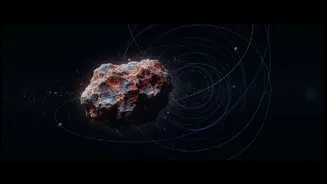
Lucy’s first test of this principle came in November 2023 with its flyby of a small main-belt asteroid named Dinkinesh. Ground-based observations had hinted that Dinkinesh might not be alone, but no one was prepared for what Lucy found. The first close-up images revealed not just a moon, but a 'contact binary' satellite—two smaller asteroids gently fused together, orbiting the main body. It was the first time such an object had ever been seen. This stunning discovery was a perfect example of reality outstripping prediction. The flyby not only provided invaluable data on a new type of celestial formation but also proved the spacecraft’s tracking systems could handle even the smallest, most challenging targets—a critical capability for its future encounters.
Another Flyby, Another Mystery
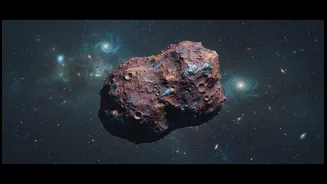
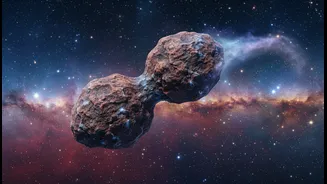
The mission's second flyby, of the asteroid Donaldjohanson in April 2025, provided a different kind of lesson. Pre-flyby models correctly identified it as a fragment from a larger collision and estimated its slow rotation. But the close-up images revealed a far more complex story. Donaldjohanson turned out to be a strangely peanut-shaped object in a chaotic, wobbling tumble, not the simple spin scientists expected. This complex rotation was a detail impossible to discern from Earth. The data showed how a combination of its violent birth and the subtle, long-term pressure of sunlight had shaped its evolution. In this case, the models were a good first draft, but the flyby provided the critical edits that revealed the asteroid's eventful history, including traces of ancient water preserved on its surface.
Sharpening Our Eyes for the Real Prize
Each flyby serves as more than just a scientific encounter; it is a vital calibration of our methods. When models are proven wrong, as with Dinkinesh's surprising moon, it forces scientists to rethink their assumptions and discover new phenomena. When models are partially confirmed but dramatically enhanced, like with Donaldjohanson, it refines their understanding and shows what subtle details long-range observations might be missing. Both outcomes are a win for science. These main-belt encounters are essentially sharpening the tools and honing the skills of the Lucy team. Every lesson learned from these 'practice runs' will make the observations of the Trojan asteroids—the mission's ultimate goal—that much more powerful and insightful.