
What Makes a Forest Primeval?
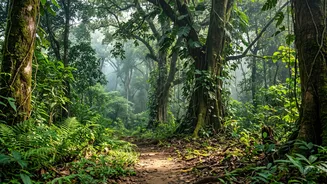
Spanning over 140,000 hectares across the border of Poland and Belarus, Białowieża is a designated UNESCO World Heritage site for a reason. It is one of the largest and last remaining parts of Europe's old-growth forests. Unlike managed woodlands where
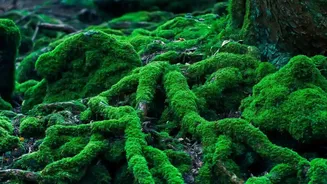
trees are often uniform in age and species, Białowieża is a complex, multi-layered ecosystem. Here, life and death are visibly intertwined. Fallen giants are left to decay, becoming nurseries for seedlings and creating a rich habitat for over 12,000 species of invertebrates, rare fungi, and mosses. This cycle of decay and rebirth, largely undisturbed by human hands, is what gives the forest its primeval character and fuels its incredible biodiversity.
The Kingdom of the European Bison
The forest's most iconic resident is the European bison, the continent's heaviest land animal. These magnificent creatures once roamed across Europe but were hunted to extinction in the wild. The last wild bison was shot in this very forest in the early 20th century. Through a remarkable conservation effort starting in 1929, bison from zoos were reintroduced into Białowieża. The reintroduction was a resounding success. Today, the Polish part of the forest alone is home to a free-roaming population of around 800 bison, the largest in the world. Their return has restored a key element of the ecosystem, making Białowieża a symbol of successful wildlife restoration.
A Sanctuary Through Centuries
Białowieża’s survival is no accident. Its history of protection dates back to the 14th and 15th centuries when Polish kings and Lithuanian grand dukes declared it a royal hunting ground, forbidding the felling of trees. This status continued under the Russian Tsars, who valued it as an exclusive game reserve. This long-term protection, established centuries before the modern conservation movement, allowed it to escape the widespread deforestation that cleared most of Europe's ancient woodlands. After surviving two World Wars, its core was eventually declared a national park, cementing its status as a natural treasure to be preserved for science and posterity.
Modern Threats to an Ancient World
Despite its protected status, Białowieża is not immune to modern pressures. In recent years, it has faced significant threats that have alarmed scientists and conservationists worldwide. Large-scale logging operations, justified by officials as necessary to combat a bark beetle outbreak, were deemed illegal by the European Court of Justice after intense public and scientific protest. Critics argued that such outbreaks are natural processes in an old-growth forest and that removing dead wood harms the countless species that depend on it. More recently, the construction of a border wall between Poland and Belarus has physically fragmented the forest, disrupting wildlife movement and raising concerns about the long-term ecological integrity of this transboundary World Heritage site. Climate change also poses a growing threat, potentially altering the forest's delicate hydrological balance.
A Living Laboratory for the Planet
Beyond its beauty and bison, Białowieża serves as an invaluable living laboratory. It provides a baseline for scientists to understand how natural forest ecosystems function without significant human interference. It is a haven for hundreds of bird species, as well as elusive mammals like the wolf and lynx. The sheer diversity, from microscopic organisms to towering, centuries-old oaks, makes it an irreplaceable reservoir of genetic information. In a world of managed landscapes, Białowieża is a benchmark for what nature can achieve when left to its own devices, offering crucial lessons for rewilding and restoration projects elsewhere. Its continued protection is not just a national issue for Poland and Belarus, but a global responsibility.