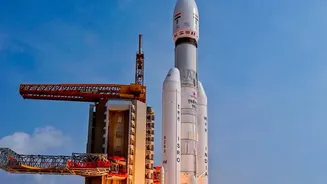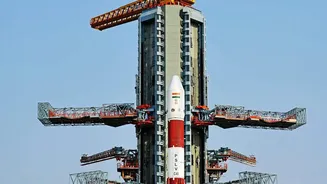







The Astronauts' Only Sanctuary
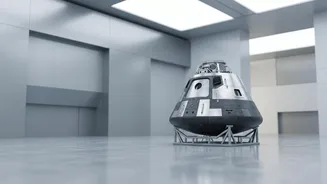
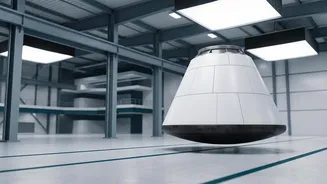
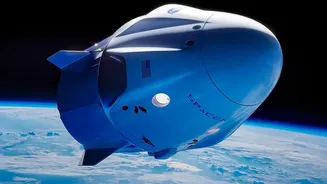
Before Indian astronauts, or Vyomanauts, can journey into space, their ride must be proven safe beyond any doubt. The centerpiece of this assurance is the Gaganyaan Crew Module (CM), a pressurized capsule designed to be their home and shield for the three-day
mission. This module is where the crew will live in a 400-kilometer-high orbit and, most critically, what will bring them back to Earth. Everything from the life support systems providing breathable air to the structural integrity that withstands the violent forces of re-entry is packed into this compact vehicle. Its performance is not just a mission objective; it's the sole factor determining crew survival. That is why the Indian Space Research Organisation (ISRO) is putting the module through an exhaustive gauntlet of tests on the ground, long before it ever sits atop a rocket.
Test 1: Surviving the Splashdown
A mission is only successful once the crew is safely recovered. For Gaganyaan, the final leg of the journey is a splashdown in the ocean. However, landing in water is unpredictable. To address this, ISRO successfully conducted a vital qualification test on the Crew Module Up-righting System (CMUS). This system is designed to ensure the capsule orients itself upright after hitting the water, even if it lands upside down or at an angle. The test involved using a stored, cold-gas-based inflation system to deploy flotation bags. By demonstrating that these bags can inflate reliably and quickly, ISRO confirmed that the crew will remain in a stable and correct position while awaiting recovery teams, a fundamental requirement for post-mission crew safety.
Test 2: A Clean Break Before Re-entry
The Gaganyaan spacecraft consists of two main parts: the Crew Module and the Service Module (SM). The Service Module provides power and propulsion in orbit, but it must be jettisoned before the Crew Module begins its fiery descent through Earth's atmosphere. The connection between these two is the umbilical system, a set of electrical and fluid lines. A recent test focused on the Umbilical Separation System, which ensures these connections sever cleanly at the right moment. If the separation is not perfect, it could disastrously alter the Crew Module's trajectory or stability during re-entry. The successful test validated that the module’s structure can handle the separation forces and that the system functions with the required design margins, clearing another critical hurdle for a safe return.
Test 3: Clearing the Path for Parachutes
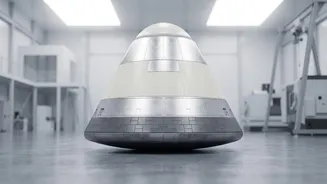
Slowing the Crew Module from orbital velocity is a multi-stage process, culminating in the deployment of a sequence of parachutes. These parachutes are protected during launch and re-entry by an Apex Cover. This cover must be jettisoned at a precise altitude to allow the parachutes to deploy. However, this separation event itself involves pyrotechnic charges that exert significant force on the Crew Module's structure. ISRO conducted a structural qualification test where it applied loads equivalent to 1.75 times the estimated forces of this separation event. The test confirmed the module's structural integrity, ensuring that the act of uncovering the parachutes does not cause any damage that could compromise the capsule or the parachute system itself.
A Symphony of Safety Checks
This trio of successful qualifications is part of a much broader and relentless testing campaign. ISRO has also been conducting Integrated Air Drop Tests (IADT), where a full-scale mock crew module is dropped from a Chinook helicopter to validate the complex, ten-parachute deceleration system. Other precursor missions include Pad Abort Tests (PAT), which test the crew's ability to escape an emergency on the launchpad, and Test Vehicle (TV) flights that simulate in-flight abort scenarios. Each test, whether on the ground or in the air, is designed to prove one thing: every system will perform flawlessly when the astronauts' lives depend on it.