


A Groundbreaking Glimpse
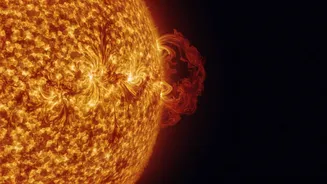
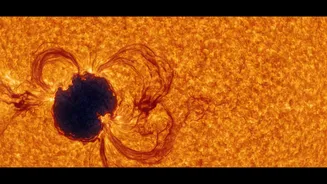
Scientists have released the highest-resolution image ever taken of the Sun's surface in visible light, offering a dramatic and intricate view of our star. Captured by the National Science Foundation's Daniel K. Inouye Solar Telescope in Hawaii, the image provides
a new level of clarity, showing features as small as a city. While the headline mentions NASA, and the agency is a key player in solar science, these specific groundbreaking images come from the NSF-funded observatory on the island of Maui. The facility's massive four-meter mirror allows it to collect more sunlight than any other solar telescope, producing exceptionally clear pictures of the photosphere, the Sun's visible surface. The images were initially taken to test the telescope's capabilities, but the results were so extraordinary that they have marked the beginning of a new era in solar physics.
What These New Images Reveal
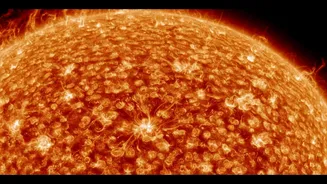
The photos show a landscape of turbulent, boiling plasma that covers the entire sun. What looks like a pattern of golden cells, each about the size of Texas, is the signature of violent convection currents. Hot plasma rises in the bright centers of these 'granules,' cools, and then sinks back down in the dark lanes between them. For the first time, scientists have also directly observed a long-theorized phenomenon known as the Kelvin-Helmholtz instability (KHI) on the solar surface. This occurs when streams of solar plasma flow past each other at different speeds, creating swirling vortices that have been compared to the brushstrokes in Van Gogh's famous painting, 'The Starry Night.' These swirls and streaks had been predicted by theory for decades but were impossible to see until now.
The Science of a Restless Star
Observing these incredibly fine details is about more than just capturing a stunning cosmic portrait. Understanding the micro-level physics of the Sun is crucial for grasping its overall behavior. The discovery of Kelvin-Helmholtz instabilities provides a new window into how energy and magnetism move across the Sun. Scientists believe these tiny, dynamic swirls could play a significant role in heating the Sun's outer atmosphere, the corona, to its mysteriously high temperature of over a million degrees. By studying these processes up close, researchers can build more accurate models of how the Sun works, which is the key to understanding all other stars in the universe.
Why A Sharper Sun Matters for Earth
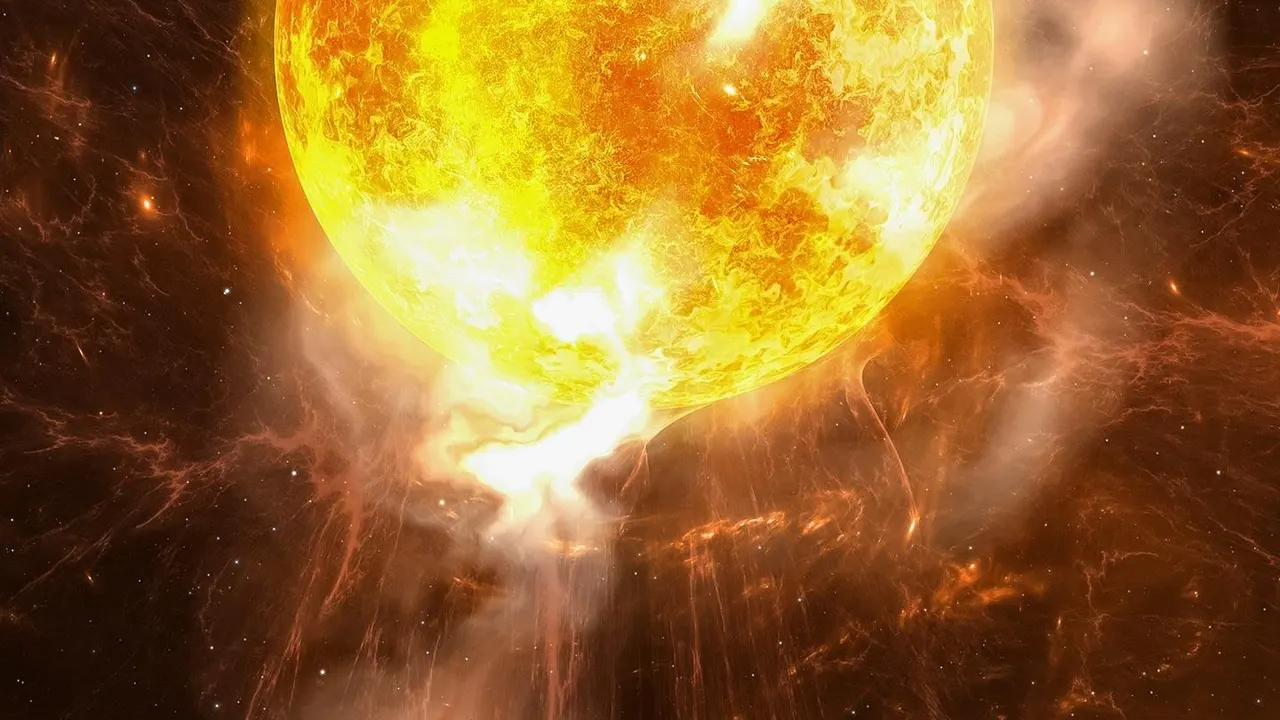
The Sun's activity has a direct impact on our planet in the form of 'space weather.' Massive bursts of energy, such as solar flares and coronal mass ejections (CMEs), can hurl charged particles toward Earth. These solar storms can disrupt our satellites, scramble GPS and communication signals, and even damage power grids. By getting a clearer view of the small-scale processes that drive this activity, scientists hope to improve their ability to predict space weather. Understanding the Sun's complex magnetic fields and plasma flows, which are now visible in unprecedented detail, is a major step toward forecasting these events and protecting our increasingly technology-dependent world.