



A Formal Pact for a Nuclear Future
On October 8, 2026, NASA and the Department of Energy (DOE) signed a Memorandum of Understanding titled 'Accelerating American Leadership in Space Nuclear Power and Propulsion'. This formalizes a partnership that will cover the full lifecycle of space
nuclear technology, from initial research and fuel development to testing, integration, and mission operations. The goal is to leverage the DOE's expertise in nuclear science with NASA's experience in space exploration to create safe and reliable systems for ambitious future missions. This agreement strengthens existing collaborations and is seen as a pivotal step in enabling a sustained human presence on the Moon and, eventually, crewed missions to Mars.
Why Go Nuclear in Space?
For decades, space missions have relied on chemical rockets and solar panels. However, these technologies have limitations. Chemical rockets are inefficient for long journeys, requiring massive amounts of propellant. Solar panels become increasingly ineffective as spacecraft travel farther from the sun and are impractical for powering a base through a two-week-long lunar night. Nuclear power offers a solution. Fission systems can provide a constant, abundant source of energy regardless of sunlight, and nuclear propulsion can be more than twice as efficient as the best chemical rockets. This means spacecraft can be lighter, carry more scientific equipment, and travel much faster, significantly cutting down transit times for astronauts.
Powering Bases on the Moon and Mars
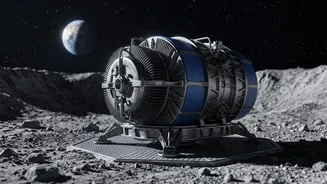
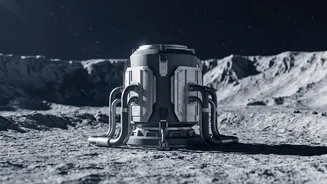
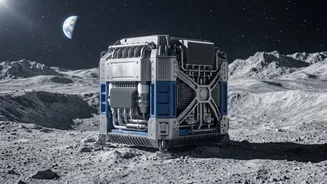
A key focus of the partnership is the Fission Surface Power (FSP) project. The goal is to develop a small, lightweight nuclear fission reactor that can be deployed on the Moon or Mars to provide a steady supply of electricity. NASA is aiming to have a demonstration unit ready to launch for a lunar mission by the early 2030s. A single FSP unit could generate around 40 kilowatts of power—enough to power several households continuously for about a decade. This reliable energy source is critical for running habitats, life support systems, rovers, and experiments needed to sustain a long-term human presence far from Earth.
Faster Journeys Through the Cosmos
Beyond powering surface operations, the agreement also accelerates the development of nuclear propulsion. The two main types being explored are Nuclear Thermal Propulsion (NTP) and Nuclear Electric Propulsion (NEP). In an NTP system, a reactor heats a liquid propellant, like hydrogen, turning it into a hot gas that exits a nozzle to create powerful thrust. This high-thrust, high-efficiency method could cut the travel time to Mars by up to 25%, reducing astronaut exposure to dangerous cosmic radiation. NEP systems use the reactor's heat to generate electricity, which then powers highly efficient ion thrusters. While NEP provides lower thrust, it is incredibly efficient over long periods, making it ideal for deep-space robotic missions.
An Uncompromising Commitment to Safety
Both NASA and the DOE have emphasized that safety is the central pillar of this entire endeavor. Nuclear systems for space have been used safely for over 50 years, primarily in the form of radioisotope power systems (RPS) that have powered missions like the Voyager probes and Mars rovers. For fission reactors, multiple safety layers are built into the design. Key strategies include only activating the reactor once it is in a safe orbit, far from Earth, and designing systems to burn up and disperse harmlessly in the upper atmosphere in the event of an accidental reentry. International protocols are also in place, requiring notification through the International Atomic Energy Agency (IAEA) in the unlikely event of an accident involving a nuclear power source in space.