


The Journey of Rain is Getting Longer
For years, our understanding of the water cycle was relatively straightforward: water evaporates, forms clouds, and falls back to Earth as rain or snow. While scientists knew this water could travel, new research confirms that in a warming world, the distance
and time involved are significantly increasing. A study led by researchers at the University of Wyoming provides the first historical confirmation of what climate models have long predicted. Their analysis shows that in certain areas, water vapor now travels an average of 50 to 80 kilometres farther than it did just 35 years ago. This means a water molecule spends an extra two to four hours in the atmosphere before it falls as precipitation. This isn't just a minor statistical shift; it represents a fundamental change in our planet's circulatory system.
Why is This Happening?
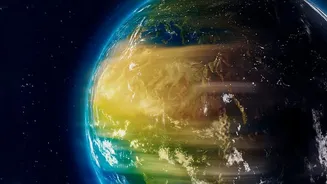
The primary driver of this change is rising global temperatures. Warmer air has a greater capacity to hold water vapor, allowing moisture to be carried for longer distances before it condenses into rain. This is amplified by changes in large-scale atmospheric patterns, such as atmospheric rivers—vast corridors of moisture in the sky—which are becoming more intense. Furthermore, the sources of this moisture are shifting. Research indicates that a greater proportion of atmospheric water is now coming from oceans rather than from evaporation over land. Human activities, such as deforestation and agriculture, also play a role by altering how much water is released from the land into the atmosphere, a process known as evapotranspiration. These combined factors are stretching the water cycle, making it more globalised and interconnected.
A More Connected, More Vulnerable World
This expanded water cycle means that what happens in one part of the world can have a more direct and pronounced impact on weather in another. For example, evaporation from the Amazon rainforest is responsible for more than half the rainfall in large parts of South America. Similarly, moisture from the Congo forest is transported to West African nations. As these transport distances grow, the links become even more critical. Deforestation in one continent could more severely impact agricultural yields or water supplies in another. This heightened connectivity makes regional water security increasingly dependent on global land management and climate policies. It underlines that a nation's water resources are often influenced by factors far beyond its own borders, demanding greater international collaboration.
Implications for India's Water Future
For India, a nation deeply reliant on seasonal monsoons, these findings are particularly significant. The Indian monsoon is a complex system fed by moisture from the Indian Ocean and surrounding seas. Changes in the transport of this moisture could alter the timing, intensity, and distribution of monsoon rains, with cascading effects on agriculture, drinking water, and the economy. An increasingly erratic water cycle, swinging between drought and deluge, is already being observed globally. As the distance between evaporation sources and rainfall locations widens, predicting these patterns becomes even more challenging. This research underscores the need for India to not only refine its own water management strategies but also to actively participate in global conversations about land use and climate change, as the stability of its water supply is intrinsically linked to the health of ecosystems thousands of kilometres away.
Improving Our View of the Future
This new understanding of a longer water cycle is crucial for sharpening our climate models. By incorporating more accurate data on how far moisture travels, scientists can create more reliable predictions for future weather patterns, including the frequency and severity of droughts and floods. As researchers integrate these complex human and atmospheric interactions, our ability to forecast long-term water availability will improve. This allows for better planning, from managing groundwater reserves to designing infrastructure capable of withstanding more extreme weather events. The discovery that our rain has a longer and more complex backstory is a powerful reminder of how interconnected our planet is, and how changes in one area can ripple across the globe.