





A Moon That Thinks It's a Planet
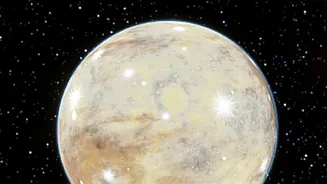
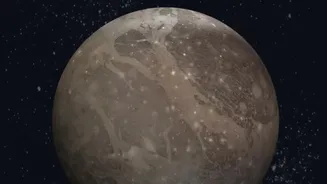
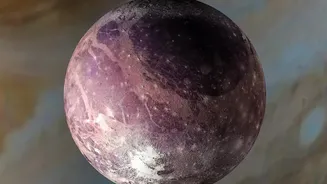
When you think of a moon, you might picture a small, cratered rock. Ganymede is anything but. With a diameter of about 5,268 kilometers, it is the largest and most massive moon in our solar system. To put that in perspective, it’s about 8% wider than
the planet Mercury. While Mercury is denser and more massive due to its metallic composition, Ganymede's sheer volume places it in a class of its own. If it were orbiting the sun instead of Jupiter, it would almost certainly be classified as a planet. It’s composed of roughly equal parts silicate rock and water ice, a mixture that makes it less dense than rocky worlds but also allows for a fascinating internal structure. Its size alone makes it a world of immense interest, but what lies beneath its surface is even more extraordinary.
The Ocean Hiding in Plain Sight
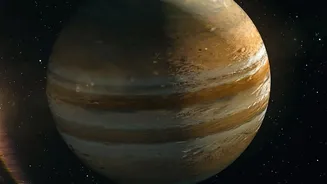
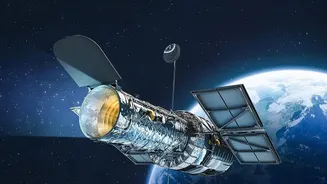
The most tantalizing feature of Ganymede is its colossal subsurface ocean. Evidence gathered by NASA's Galileo mission and later the Hubble Space Telescope confirms that a vast body of saltwater exists beneath its icy crust. This isn't just a small sea; scientists estimate the ocean is around 100 kilometers deep, which is ten times deeper than Earth's oceans. It’s believed to contain more water than all of Earth's surface oceans combined. The main evidence for this ocean comes from studying Ganymede’s auroras. The way these polar lights “rock” back and forth in response to Jupiter’s changing magnetic field suggests the presence of an electrically conductive saltwater ocean that influences the moon's own magnetic field.
The Only Moon With Its Own Magnetic Field
Adding to its planetary-like status, Ganymede is the only moon in the solar system known to generate its own intrinsic magnetic field. This field is created by a convecting, liquid iron core, similar to how Earth's magnetic field is generated. The discovery by the Galileo spacecraft in 1996 was a surprise, as a body of its size was expected to have cooled down long ago. This magnetic field is strong enough to create its own miniature magnetosphere, carving out a protected bubble within Jupiter’s much larger magnetic field. This unique feature is responsible for the auroras at its poles and points to a geologically active interior, a key ingredient when considering a world’s potential for habitability.
A 'Club Sandwich' of Ice and Water
Ganymede’s interior isn’t just a simple case of ice over water. Scientific models suggest a far more complex structure, sometimes described as a “club sandwich.” An analysis in 2014 proposed that Ganymede could have multiple ocean layers separated by different phases of ice. This means there could be a stack of liquid water and solid ice layers extending hundreds of kilometers down to the rocky mantle. At the extreme pressures found deep inside Ganymede, water can form different types of high-pressure ice that are denser than the liquid water above, allowing for this incredible layering. This complex internal plumbing makes Ganymede even more dynamic and mysterious than previously thought.
The Quest for Answers with JUICE
Because of these incredible features, Ganymede is a primary target for future exploration. The European Space Agency's (ESA) JUpiter ICy moons Explorer (JUICE) mission is set to perform an in-depth investigation of this fascinating world. A key goal is to characterize its hidden ocean, map its surface, and study its unique magnetic field in unprecedented detail. JUICE will eventually become the first spacecraft to orbit a moon in the outer solar system, dedicating its final mission phase to Ganymede. By using tools like ice-penetrating radar, the mission aims to probe the icy crust and better understand the geology of this potential habitat. The mission will also search for biosignatures, or the chemical building blocks of life, to assess its habitability.