
The Sun's Boiling Surface
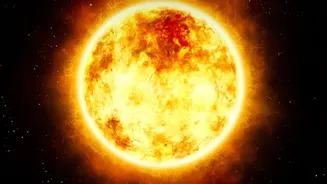
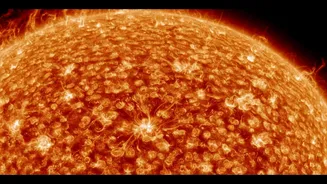
If you could look at the sun’s surface up close, you wouldn’t see a smooth, even glow. Instead, you would see a pattern that looks like a pot of boiling water, but on a colossal scale. This pattern is called granulation, and the individual cells are known
as solar granules. Each granule is a massive bubble of hot plasma, often the size of a country or even a continent like India. Hot plasma rises in the bright centers of these cells, spreads across the surface, cools, and then sinks back down along the dark, narrow lanes between them. This process, called convection, is the sun’s primary way of transporting heat from its interior to its surface. These granules are short-lived, lasting only about eight to 20 minutes before dissipating and being replaced by new ones, creating a constantly evolving, turbulent landscape.
Capturing the Impossible
Getting a clear, detailed image of these granules is incredibly difficult. Viewing the sun from Earth is like looking at a coin at the bottom of a swimming pool; our planet’s turbulent atmosphere blurs and distorts the light. For solar telescopes on the ground, this is a major hurdle. However, the U.S. National Science Foundation's Daniel K. Inouye Solar Telescope in Hawaii, the world's most powerful solar observatory, has overcome this. Using a massive 4-meter primary mirror and advanced adaptive optics—which use deformable mirrors to correct for atmospheric distortion in real-time—the telescope can produce images of the sun with unprecedented clarity. The results are the highest-resolution images of the sun’s surface ever taken, revealing features as small as 20 or 30 kilometers across.
A New Level of Detail
These new images are revealing phenomena that were only theoretical before. In images and data released in August 2026, scientists confirmed the existence of a process called the Kelvin-Helmholtz instability on the sun's surface for the first time. This instability creates tiny, swirling, whirlpool-like patterns at the edges of the granules where plasmas moving at different speeds shear against each other. Think of it like the swirls that form when wind blows over water. While long predicted by theory, these city-sized vortices had never been directly observed until the Inouye telescope provided the necessary resolution. Scientists can now see the intricate, thread-like magnetic structures weaving through the lanes between granules, which are believed to be crucial for transferring energy into the sun's upper atmosphere.
Solving Long-Standing Mysteries
This fine-detail view is more than just scientifically interesting; it's a vital tool for solving some of the biggest puzzles in solar physics. One of the most enduring mysteries is the coronal heating problem: why is the sun’s outer atmosphere, the corona, hundreds of times hotter than its surface? The tiny, bright markers of magnetic fields seen in the dark lanes between granules are thought to channel energy up into the corona. By studying the swirling instabilities and magnetic fields at this micro-level, scientists hope to finally understand the mechanisms that superheat the corona. This research, supported and analyzed by agencies like NASA, helps build a complete picture of how the sun works.
Why It Matters on Earth
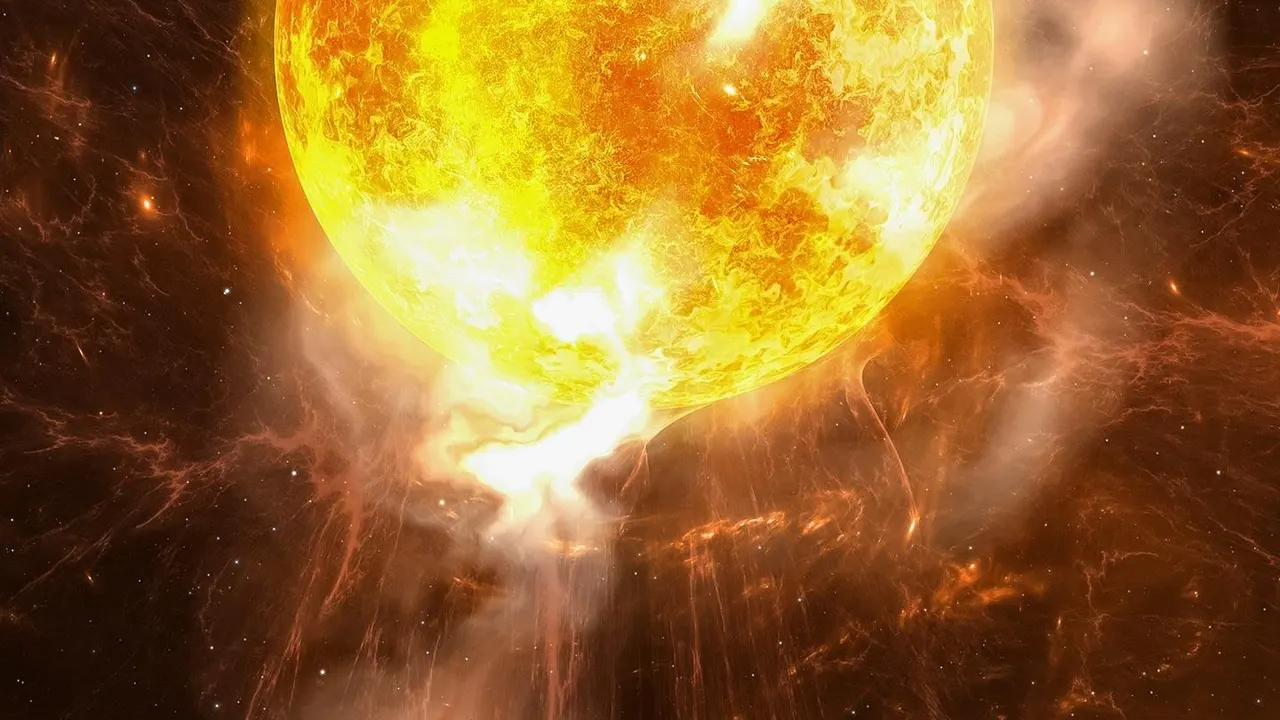
Understanding the sun’s fundamental processes has very practical implications for us on Earth. The sun's magnetic activity drives space weather, which includes phenomena like solar flares and coronal mass ejections (CMEs). These solar storms can have serious consequences, disrupting satellite communications, damaging power grids, and posing a risk to astronauts. The magnetic fields that cause these large-scale eruptions originate in the complex interplay of forces on the sun's surface, exactly where these granules are. By creating more accurate models of the sun's behavior based on these high-resolution observations, scientists can improve their ability to forecast space weather, giving us more time to prepare for potentially disruptive events.