



A Star's Final Act
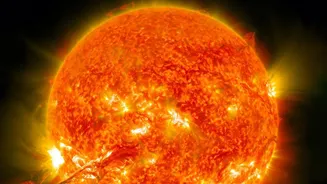
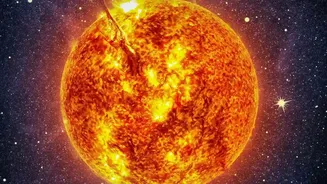
For decades, astronomers have predicted the dramatic final stages of Sun-like stars. After exhausting the hydrogen fuel in their core over billions of years, they are expected to swell into what is known as a red giant. This expansion can be immense,
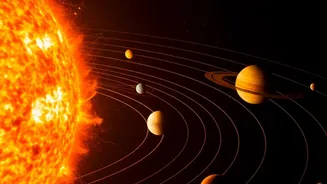
with the star growing to be hundreds or even thousands of times its original size. In this phase, the star's expanding outer atmosphere will inevitably consume any planets orbiting too closely. Scientists have long found evidence of this process by observing the chemical aftermath on stars, but catching the event in the act has been a major challenge. This cosmic engulfment is not just a distant phenomenon; it is a preview of our own Solar System's destiny. In about five billion years, our Sun will begin this same transformation, and it is expected to swallow Mercury, Venus, and possibly even Earth.
A Flash in the Night
The event that brought this theory into the headlines was designated ZTF SLRN-2020. In 2020, astronomers using the Zwicky Transient Facility (ZTF) in California noticed a star in the Aquila constellation, about 12,000 light-years away, that suddenly brightened by more than 100 times over just 10 days before fading. Initially, researchers were puzzled. The event was unlike a typical nova, where a star strips material from a companion. Follow-up investigations using other telescopes and archival data from NASA's NEOWISE infrared space telescope revealed a crucial clue. A year before the visible flash of light, the star began glowing in infrared—a sign of cool dust forming. The total energy released was also about 1,000 times less than what would be expected from two stars merging. This unique combination of a cool, dusty infrared glow followed by a hot, bright optical flash pointed to a different conclusion.
Model, Not Movie
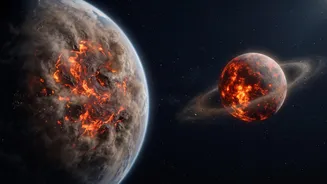
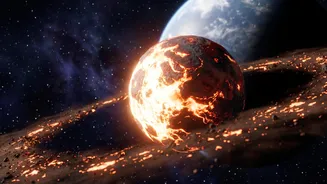
This is where the distinction between a model and a direct detection becomes critical. We did not have a telescope zoomed in on the planet as it spiraled into its star. Instead, astronomers acted as cosmic detectives, piecing together clues from different sources of light and timeframes. The best explanation—the model that fits all the data—is that a Jupiter-sized gas giant got pulled into the star's atmosphere. As it spiraled inward, it dragged gas from the star's surface, which cooled into a shroud of dust, causing the initial infrared brightening. The final plunge into the star triggered the massive burst of light and energy seen by the ZTF. The sequence of events—the infrared glow preceding the optical flash, the amount of energy released, and the composition of the ejected material—all perfectly match the predictions for a planetary engulfment. While other explanations like a stellar merger were ruled out, the conclusion is based on interpreting these after-the-fact signals, not on a direct visual recording of the event as it happened.
Searching for Chemical Fingerprints
The event ZTF SLRN-2020 is not the only way scientists hunt for planet-eating stars. Another method involves looking for unusual chemical signatures in a star's atmosphere. Stars and planets are made of different stuff; for instance, rocky planets are rich in heavy elements and chemicals like lithium that are typically destroyed inside a star's hot core. In recent studies, astronomers have identified stars with unexpectedly high levels of lithium or other refractory (heat-resistant) elements. One technique involves comparing twin stars born from the same cloud of gas and dust. Since they should have identical compositions, if one star shows an excess of these planetary materials, it's strong evidence that it has consumed one or more of its planets. These chemical fingerprints provide a different kind of proof, showing the 'after' of an engulfment, complementing the 'during' that was inferred from ZTF SLRN-2020.
A Glimpse of Earth's Future
While the idea of a star swallowing a planet is dramatic, it provides a sobering look at the long-term forecast for our own world. For about five billion years, the Sun will remain stable. But after that, its red giant phase will begin. Current models predict it will expand beyond the orbits of Mercury and Venus, consuming them entirely. Earth's fate is less certain. While some models predict it will also be engulfed, recent research suggests that as the Sun expands, it will lose mass, weakening its gravitational pull. This could allow Earth's orbit to drift outwards, potentially saving the planet itself from being swallowed, though not from being scorched. Long before that, in about a billion years, the Sun's increasing brightness will likely boil our oceans and make the surface uninhabitable, ending life as we know it. The observations of ZTF SLRN-2020 are therefore more than just an astronomical curiosity; they are a real-world example of the processes that will one day reshape our own corner of the galaxy.