





A Poem's Birth
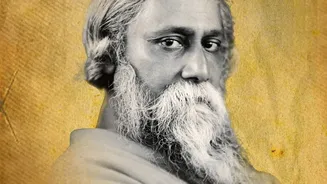
The story of Jana Gana Mana begins on December 11, 1911, when Rabindranath Tagore composed a five-stanza poem in a highly Sanskritised Bengali, titled 'Bharoto Bhagyo Bidhata'. Published in January 1912 in the Tatwabodhini Patrika, the journal of the Brahmo
Samaj, the poem was intended as a hymn. It was conceived not as a political song but as a spiritual and philosophical reflection on the destiny of India, addressing a divine power as the 'dispenser of India's destiny'. This nuanced origin is often overlooked in the powerful, patriotic context the song holds today.
A Public Debut
The poem's first public performance as a song happened just weeks after its composition. On December 27, 1911, it was sung at the annual session of the Indian National Congress in Calcutta. It was not Tagore himself, but his niece, Sarala Devi Chowdhurani, who led a group of students in presenting the song to the assembled delegates. This performance marked a pivotal moment, introducing the composition to the very heart of India's emerging nationalist movement. It was noted in Congress records simply as a patriotic song, one among several cultural expressions of a growing national consciousness.
The Persistent Controversy
Almost immediately, a controversy arose that would shadow the song for decades. The 1911 Congress session occurred around the same time as the Delhi Durbar for King George V, leading some Anglo-Indian newspapers to erroneously report that Tagore's song was an ode to the British monarch. Tagore was dismayed by the suggestion. He later clarified in letters that the 'Lord of Destiny' in his song was the eternal guide of India, not any earthly king like George V. He wrote that the request to compose a song for the Emperor had amazed and disturbed him, and Jana Gana Mana was his response, dedicated to the divine force guiding India's journey.
A Song for a Nation in the Making
Despite the controversy, the song's popularity grew organically within nationalist circles. In 1919, Tagore himself translated it into English as 'The Morning Song of India' during a visit to the Besant Theosophical College in Madanapalle, Andhra Pradesh. This version helped spread its message to a wider audience. The song's journey took a significant turn when Netaji Subhas Chandra Bose adopted it for the Indian National Army (INA). While in Germany in 1942, a version of Jana Gana Mana was played by the Hamburg Radio Symphony Orchestra as the anthem of a free India. Later, Bose commissioned a Hindustani translation by Captain Abid Hasan Safrani, which became 'Subh Sukh Chain', the official anthem of the Provisional Government of Free India. This martial adaptation cemented the song's role as a powerful symbol of the freedom struggle.
The Official Anthem
By the time India gained independence in 1947, Jana Gana Mana was already a strong contender for the national anthem. It was sung at the closing of the historic midnight session of the Constituent Assembly on August 14, 1947. In the ensuing debates, it was considered alongside Bankim Chandra Chattopadhyay's 'Vande Mataram'. While 'Vande Mataram' was deeply cherished for its role in the freedom movement, 'Jana Gana Mana' was seen by many as more suitable for collective singing and orchestration. On January 24, 1950, Dr. Rajendra Prasad, President of the Constituent Assembly, announced that Jana Gana Mana would be India's national anthem, while 'Vande Mataram' would be honoured as the national song. This decision was a formal recognition of a song that had already won its place in the nation's heart.