





A World Forged by a Gravitational War
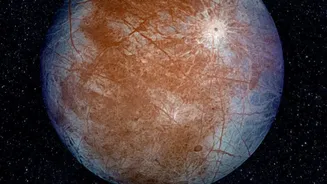
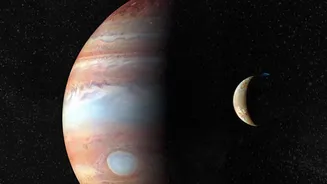
Imagine being constantly stretched and squeezed by a force more than 2,000 times stronger than Earth's gravity. This is the daily reality for Io. Caught in a gravitational tug-of-war between the colossal planet Jupiter and its neighbouring moons, Europa
and Ganymede, Io’s interior is subject to immense friction. This process, known as tidal heating, generates an enormous amount of heat, making the moon a planetary furnace with hundreds of active volcanoes. Its surface is a chaotic canvas of lava flows and sulphur deposits, with a total heat flow more than 20 times that of Earth. Until now, scientists could only observe this heat as it erupted from volcanoes or radiated from the very top layer of the surface. The plumbing system below remained a complete mystery.
Peeking Beneath the Crust
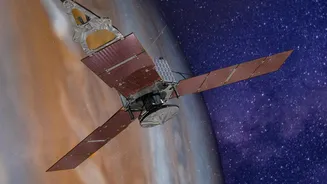
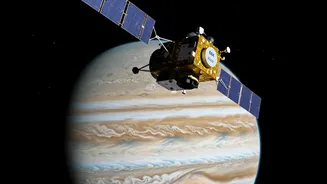
The breakthrough came from an unlikely source: an instrument designed to peer through Jupiter's thick clouds. During two close flybys in late 2023 and early 2024, NASA's Juno spacecraft aimed its Microwave Radiometer (MWR) at Io. For the first time, scientists were able to measure temperatures not just at the surface, but several feet below it. What they found was a steep temperature gradient. In some places, the temperature rose by more than 22 degrees Celsius just a few feet underground—a change far too significant to be caused by sunlight alone. This was the first direct evidence of heat moving up through the crust from the interior, a crucial clue to understanding Io's volcanic engine.
Two Paths for the Rising Heat
The Juno data points to two main ways Io might be releasing its internal energy. The first possibility is a steady, widespread conduction of heat through the crust. Think of it as a gentle, constant warmth radiating upwards everywhere, releasing a total amount of energy that is up to 30 times Earth's average. The second, and perhaps more dramatic, explanation involves pockets of cooling lava just beneath the surface. These magma flows, covered by a thin, solidified crust only about 30 to 35 feet thick, would create localised hotspots. Data showed specific zones that were 10 to 20 degrees Celsius warmer than their surroundings, which could represent these near-surface lava deposits or pathways for heat to escape from deeper within the moon.
A Surprisingly Smooth and Porous World
Beyond the heat, Juno's observations uncovered another surprise. Despite its towering mountains and violent eruptions, large parts of Io's surface appear to be remarkably smooth. The data also suggests that the upper layer of the crust is made of unusually low-density, porous material. This could be something akin to fluffy volcanic ash or pumice, the lightweight, hole-filled rock that can float on water. This discovery challenges previous assumptions about the moon's surface composition and suggests a complex geological history of repeated eruptions laying down layers of light, airy material across its plains.
A Laboratory for Other Worlds
Understanding how Io works has implications that extend far beyond Jupiter. According to Scott Bolton, Juno's principal investigator, Io provides a unique natural laboratory for studying tidal heating—a fundamental process that heats worlds far from their star. This same mechanism is believed to be what maintains the liquid water oceans hidden beneath the icy shells of other moons like Europa and Ganymede. The techniques used to probe Io's subsurface could even be applied back here on Earth. A similar microwave instrument could potentially detect temperature changes beneath terrestrial volcanoes, offering new insights into their internal workings and possibly improving our ability to forecast eruptions.