







Ever wonder why a stroke on the right side of the brain affects the left side of your body? This strange, crisscross wiring is a deep evolutionary puzzle. Now, a new hypothesis suggests the answer isn't in our limbs, but in our ancient ancestors' eyes.
The Body's Great Mix-Up
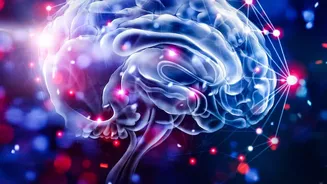
It is one of the most fundamental facts of our biology: the left hemisphere of our brain controls the right side of our body, and the right hemisphere controls the left. This feature, known as contralateral organization, is a hallmark of all vertebrates, from fish to humans. For centuries, scientists have debated why this seemingly complicated arrangement exists. Wouldn't it be simpler and more efficient for nerves to travel straight from the brain to the body on the same side? This crossing, called decussation, happens at various points, most notably in the brainstem, where major motor and sensory pathways swap sides. The phenomenon is so consistent that it’s a cornerstone of modern neurology, but its evolutionary origin has remained a mystery.
Old Puzzles and Prior Theories
Before this new idea, several theories attempted to explain our crossed wiring. One prominent idea is the 'somatic twist hypothesis,' which suggests that during the evolution from invertebrates (which have nerve cords on their belly side) to vertebrates (with spinal cords on their back), our distant ancestors' entire body twisted 180 degrees behind the head. This physical rotation would have naturally twisted the nerve pathways, creating the crossover we see today. Another theory proposed that the crossing helps integrate vision and touch, allowing for faster reactions. While intriguing, none of these explanations has been universally accepted, leaving the door open for a new perspective.
A New Hypothesis: It All Started With the Eyes
Recently, a new hypothesis published in 'Frontiers in Neuroanatomy' by researchers Dr. Martin Wessendorf and Daniel Wang from the University of Minnesota offers a different and compelling explanation. They propose that our contralateral wiring isn't a specific adaptation that offered a survival advantage on its own. Instead, it’s an evolutionary echo, a byproduct of a blueprint laid down more than 500 million years ago by the visual system of our earliest vertebrate ancestors. The researchers argue that evolution is a conservative engineer; it often builds upon existing structures rather than starting from scratch. In this case, the ancient wiring of the eyes may have set the template for everything that followed.
An Ancient Visual Blueprint
The argument begins with the basic physics of a lens, which inverts an image. What you see in your right visual field is projected onto the left side of your retina, and vice versa. To make sense of this, the earliest vertebrates developed a brain structure called the optic tectum (known as the superior colliculus in mammals). To create a coherent map of the world, nerve fibres from the eyes crossed at a structure called the optic chiasm, sending signals from the right visual field to the left optic tectum, and from the left visual field to the right. This contralateral visual map is present in every single vertebrate known, suggesting it’s incredibly ancient. The new hypothesis posits that this visual cross-wiring was the original, foundational blueprint. As other sensory and motor systems evolved, they simply plugged into this pre-existing contralateral map to ensure all the information aligned. It was simply the most 'economical' way to wire a growing, complex brain.
Why This New Idea Matters
This 'vision-first' hypothesis elegantly explains why so many different pathways—for touch, hearing, and motor control—all adopted a crossed pattern. They were following the leader. For example, the pathway that gives us fine motor control in our fingers, the corticospinal tract, is a relatively recent evolutionary development found in mammals. The researchers suggest that this pathway was co-opted from an older, crossed sensory circuit. Rather than evolving a brandnew system, evolution repurposed existing contralateral wiring for a new function. The authors stress that this is a hypothesis that needs further testing, perhaps by examining ancient fossils for evidence of these brain structures. But it provides a powerful new framework for understanding not just a quirk of anatomy, but any principles by which evolution builds complex systems—layer by layer, upon any foundations of what came before.