




Meet the Lion Nebula
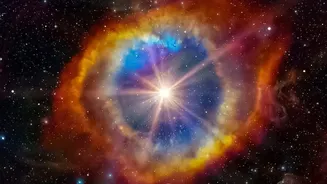
Located roughly 5,000 to 6,500 light-years away in the constellation Gemini, NGC 2392 is what astronomers call a planetary nebula. The name is a historical holdover; they have nothing to do with planets. Instead, they represent the final, beautiful act
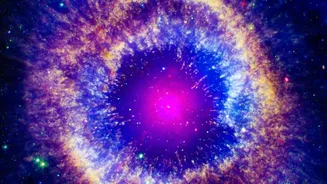
of a Sun-like star. When such a star exhausts its fuel, it sheds its outer layers of gas and dust into space. The hot, dense core left behind, called a white dwarf, then illuminates this expelled material, creating the glowing structures we can observe. NGC 2392 has earned the nickname the "Lion Nebula" because its intricate shells of gas and dust resemble the head and mane of a lion. The white dwarf at its heart appears like a bright button nose. The object was first discovered in 1787 by William Herschel. For a long time, it was also known by another nickname, the "Eskimo Nebula," but NASA and the scientific community have discontinued this term due to its offensive and colonial history.
Webb’s Two Ways of Seeing
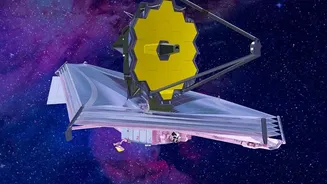
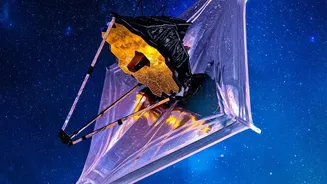
While the Hubble Space Telescope gave us breathtaking views of NGC 2392 in visible light, Webb’s power lies in its ability to see the universe in infrared. This is crucial for understanding objects like planetary nebulae, as infrared light can pierce through obscuring dust and reveal cooler structures. To capture this latest portrait, Webb used two of its key instruments: the Near-Infrared Camera (NIRCam) and the Mid-Infrared Instrument (MIRI). Think of them as two different sets of eyes, each specialized for a different part of the infrared spectrum. NIRCam is sensitive to shorter infrared wavelengths, which are excellent for seeing hotter gases and fine, filamentary details. MIRI, on the other hand, detects longer mid-infrared wavelengths, making it perfect for spotting cooler dust. By combining data from both, astronomers get a much more complete picture of the nebula's composition and structure.
NIRCam’s Fiery Details
In the view from NIRCam, the inner structures of the Lion Nebula are incredibly sharp. This instrument highlights the bubble of extremely hot, ionized gas being blasted away from the central star. This forms the lion's "face" and showcases cavernous shells and rings of material. The radiation from the white dwarf is so intense that it's actively destroying some of the surrounding dust. NIRCam’s view is particularly good at showing the intricate, filamentary patterns within the nebula that look like tiny pieces of shattered glass, revealing the turbulent environment created by the dying star’s powerful stellar winds.
MIRI’s Dusty Mane
Switching to the MIRI instrument reveals a different aspect of the nebula. MIRI’s view is all about the dust. It clearly shows the lion's sprawling "mane," which is the interior of a vast dust shell illuminated by the central star. This view highlights dense, clumpy structures of dust that have so far survived the star's energetic outflow. These clumps, seen in purple and cyan in the processed images, are fascinating because they are protecting the material that lies behind them, creating long, tail-like features. Without MIRI, our understanding of the distribution and temperature of this cooler dust would be incomplete.
A Cosmic Story of Life and Death
By combining the NIRCam and MIRI images, scientists can piece together a more comprehensive story of NGC 2392. We see a dynamic, evolving system where powerful forces are at play. The central star's fierce radiation and fast winds carve out a cavity, while simultaneously lighting up the outer shells of material shed thousands of years ago. The interplay between the hot gas seen by NIRCam and the cooler dust revealed by MIRI paints a vivid picture of the end of a star's life. This process is not just beautiful; it is essential for the cosmos. It enriches the galaxy with heavy elements and dust, which will one day be incorporated into new stars and, just maybe, new planets. These images are a snapshot in time; astronomers estimate the Lion Nebula will continue to expand and disperse over the next 10,000 years, eventually fading back into the interstellar medium.