




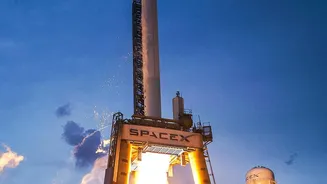

In a display of engineering that felt like science fiction, SpaceX successfully caught its Starship upper stage from orbit. This historic manoeuvre is a giant leap towards fully reusable rockets, but the ultimate prize has yet to be won.
What Just Happened?
On November 14,
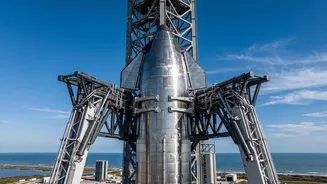
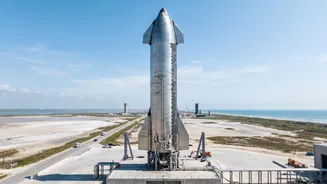
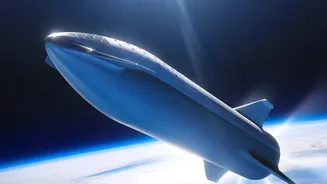
2026, after spending over 22 hours in orbit and circling the Earth 14 times, the Starship upper stage (named Ship 42) executed a precise return to its launch site in Texas. Instead of landing on legs, it was caught in mid-air by a massive pair of mechanical arms on the launch tower, a system nicknamed 'Mechazilla' or the 'chopsticks'. This marked the first time in history that an orbital-class upper stage was recovered this way. The mission, however, was a partial success; the Super Heavy booster, the rocket's first stage, failed its own catch attempt and was lost.
The Billion-Dollar Catch
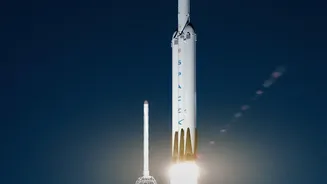
The reason for this elaborate and risky manoeuvre is simple: cost. Traditionally, rockets are single-use hardware. The upper stage, which carries the payload into orbit, is typically discarded to burn up in the atmosphere. SpaceX’s own Falcon 9, a workhorse of the industry, reuses its first stage but expends its second. Achieving full reusability for both stages could slash the cost of accessing space by a factor of 10 or more, potentially bringing the per-kilogram cost to LEO below $100. This radical cost reduction is seen as the key to unlocking new commercial space ventures, from large-scale satellite deployments to ambitious missions to the Moon and Mars.
The 'Chopsticks' Explained
The Mechazilla tower is more than just a launch platform; it's an active part of the recovery system. The 'chopsticks' are large, articulated arms that can move up, down, and sideways along the tower. During recovery, the returning rocket performs a series of engine burns to slow down and align itself with the tower. In the final moments, the arms swing into position, grasping the vehicle at reinforced points and absorbing the kinetic energy of the catch. This system eliminates the need for heavy landing legs on the rocket itself, saving mass that can instead be dedicated to payload. The idea is to catch, refuel, and relaunch the vehicle in quick succession, much like an airplane.
From Recovery to Reuse
Catching the rocket is just the first step. The headline's crucial caveat—'reuse still to be demonstrated'—points to the next major hurdle. Now that Ship 42 has been recovered, SpaceX engineers must inspect it thoroughly. The primary concern is the vehicle's thermal protection system—the thousands of hexagonal tiles that protect it from the searing heat of re-entry. Unlike the Space Shuttle, which required extensive and costly tile refurbishment between flights, Starship's system is designed for minimal maintenance. Proving that the ship can fly again quickly and economically, without a complete overhaul, is the true test of the entire system. The condition of the heat shield and the engines will determine how close SpaceX is to making rapid reusability a reality.
The Bigger Picture for India and the World
This technological leap by a private company has massive implications for the global space industry, including India's burgeoning space sector. As launch costs plummet, the barrier to entry for space-based enterprises will lower significantly. This could foster a new wave of innovation in satellite communications, Earth observation, and in-space manufacturing. For a space-faring nation like India, which is also developing its own reusable launch vehicle technologies, SpaceX's progress serves as both a benchmark and a competitive pressure. The demonstration of once-theoretical concepts like an upper-stage catch accelerates the entire industry's timeline, pushing all players to innovate faster to remain relevant in this new era of space access. Cheaper access to orbit could enable Indian startups and government agencies to deploy more ambitious projects more frequently.