




A Frozen World Revisited
When NASA's New Horizons spacecraft flew past Pluto in July 2015, it transformed our understanding of the distant world. Instead of a simple ball of ice and rock, the probe revealed towering water-ice mountains, vast plains of frozen nitrogen, and a thin,
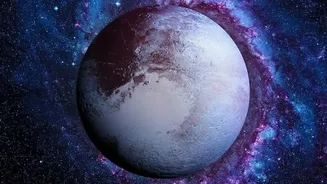
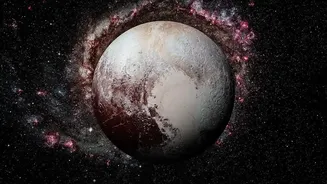
hazy atmosphere. One of the most captivating discoveries was a massive, heart-shaped glacier named Tombaugh Regio. Its western lobe, a huge basin called Sputnik Planitia, was particularly stunning. This plain of nitrogen ice, larger than Texas and Oklahoma combined, showed no impact craters, a clear sign that its surface was geologically young and was being constantly renewed. Scientists saw that the ice was churning in slow-motion convection, like a cosmic lava lamp, but the full story of Pluto's activity was still unfolding.
The Telltale Features in the Ice
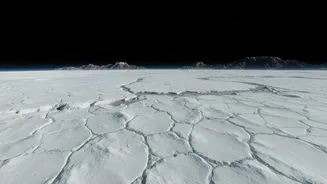
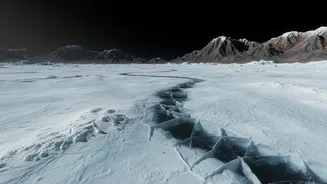
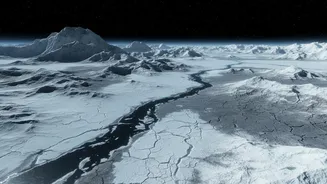
Scientists have spent years poring over the data New Horizons sent back. A new study, published in the Planetary Science Journal, focused on images of the northern edge of Sputnik Planitia. These photos showed city-sized cells of ice separated by thin, dark lines and more diffuse dark patches. A team led by Alan Stern, the principal investigator for the New Horizons mission, re-examined these features. They noticed the patterns looked remarkably similar to features on Earth's own ice sheets, like in Greenland, where meltwater darkens the surface. This comparison sparked a tantalizing question: could these dark areas on Pluto be evidence of liquid?
Could a River of Nitrogen Flow?
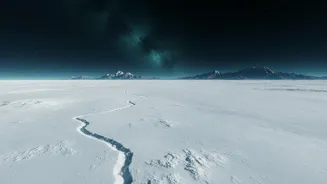
The liquid in question isn't water. Pluto's surface is far too cold for that. Instead, scientists hypothesize it is liquid nitrogen. But how could anything be liquid on a world so frigid? The planet's atmosphere is too thin to allow for nitrogen rain. The new theory suggests the liquid is coming from below. Computer models indicate that heat from Pluto's interior could be just enough to melt the nitrogen ice at the bottom of the kilometers-deep Sputnik Planitia glacier. This liquid nitrogen, being less dense than the solid ice above it, would then be forced upward through cracks and fissures, briefly flowing onto the surface before refreezing. This process of 'wetting' the surface would darken the ice, creating the very features seen in the 2015 images.
A Hypothesis, Not Yet a Fact
It's crucial to remember that this remains a compelling theory, not a confirmed discovery. The headline's use of 'may' is important. As mission leader Alan Stern noted, “Pluto never stops surprising us.” This new result suggests that Pluto could have time-variable features, meaning its surface might change in noticeable ways over time due to these flows. The idea of a geologically active Pluto, with processes similar to volcanism (but with icy slush instead of molten rock), was once unthinkable. This research, combining old data with new analysis and modeling, showcases the scientific process at its best. It builds on earlier ideas that Pluto may harbor a deep subsurface ocean of water, painting a picture of a far more complex and dynamic world than was ever imagined.